Biofertilizers biofertilizers bf are substances that contai - HiSET Prep
Question
Biofertilizers
Biofertilizers (BF) are substances that contain strains of beneficial soil microorganisms. Microorganisms present in biofertilizers colonize the root fibers of plants and promote a supply of nutrients to the plants. Nitrogen-fixing bacteria are very often used in biofertilizers. These fertilizers are well recognized as an important component of sustainable agriculture.
Researchers predict that the use of a biofertilizer-containing phosphate-solubilizing bacteria will result in better quality crops when used alone or when combined with other chemical fertilizers (CF). Researchers designed an investigation to compare the effects of different combinations of chemical and biofertilizers on cucumber yields. Researchers used two types of biofertilizers containing the soil bacteria Pseudomonas putida (BF1) and Pontoea agglomerans (BF2). They also varied the quantities of chemical fertilizers used.
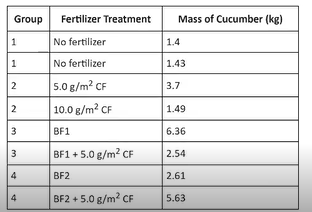
Researchers set up four experimental groups, each containing the same number of cucumber seeds but different fertilizers.
Effects of Various Treatments on the Masses of Cucumbers Grown
. Group 1 used no fertilizer.
. Group 2 used varying amounts of CF.
. Group 3 used BF1 and varying amounts of CF.
. Group 4 used BF2 and varying amounts of CF.
Which group is the control group in the investigation?
Answers
-
-
-
-
correct
Explanation
Correct Answer: D. Group 1 because it did not receive any fertilizer. Group 1 is the control group because it establishes the baseline for cucumber growth without any fertilizer influence. A control group allows researchers to compare the effects of different treatments against a natural standard. In this experiment, Group 1’s results (1.40 kg and 1.43 kg) show normal growth without biofertilizer or chemical fertilizer. All other groups introduce variables that may alter plant mass. By using a group that receives no treatment, researchers can confidently identify whether observed differences in mass result from the fertilizers or from natural variability. This control provides a benchmark to measure the impact of chemical (CF) and biofertilizers (BF1 and BF2) treatments, ensuring scientific accuracy and reliable interpretation of data in fertilizer-based experiments. Without Group 1, the study could not determine if the fertilizers truly improved crop mass.
Why Other Options are Incorrect:
-
A. Group 2 because it contained only chemical fertilizer: This group received a variable (CF), which means it is part of the experimental treatment. A true control has no applied treatment, serving only as a baseline for comparison. Group 2 cannot fulfill that role.
-
B. Group 3 because it contained both chemical and biofertilizer: The combination of CF and BF1 makes this a treatment group testing interactive effects, not a baseline. Its inclusion of experimental variables eliminates it from serving as a control.
-
C. Group 4 because it contained only biofertilizer: Although it lacks chemical fertilizer, it still involves biofertilizer, which is an experimental treatment. A control must exclude all added variables to remain valid for comparison.