Traveling marble investigation four groups of students perf - HiSET Prep
Question
Traveling Marble Investigation
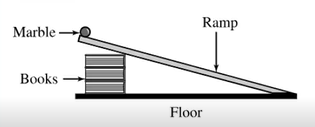
Four groups of students performed an experiment related to motion. Each group used a steel marble, a grooved ramp, and books of the same thickness to support the ramp, as illustrated in the diagram.
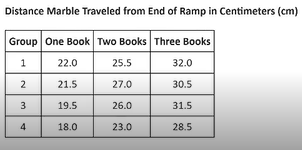
One student from each group released the marble at the top of the ramp, and another student measured the distance the marble traveled on the floor from the end of the ramp. One, two, and three books were used to support the ramp. The data are recorded in the following table.
If there were no friction, what would happen to the marble after it reached the end of the ramp?
Answers
-
correct
-
-
-
Explanation
The Correct Answer is: A. The marble would maintain its speed and direction. In a frictionless environment, Newton’s first law (the law of inertia) governs motion: an object in motion continues with constant velocity unless acted upon by a net external force. After the marble leaves the ramp and reaches the horizontal floor, gravity is balanced by the normal force, resulting in zero net vertical acceleration. With friction removed, no horizontal force opposes the marble’s motion. Therefore, its speed remains constant and it travels in a straight line along the floor. The table in the investigation shows different distances because of friction and differing launch speeds from steeper ramps; removing friction eliminates the factor that slows the marble. Direction changes require an unbalanced force, such as a wall or sideways push, which is absent here. Hence, on a level, frictionless floor, the marble maintains both speed and direction indefinitely, perfectly illustrating uniform motion in an inertial frame.
Why Other Options are Incorrect:
-
B. The marble would maintain its speed but change direction. A change in direction requires a lateral force (e.g., a turn, wall, or curvature). With no friction and no side force, the path remains straight; direction does not change.
-
C. The marble would slow down and stop. Slowing requires a retarding force. Friction is the usual cause; removing it leaves no horizontal force to reduce speed, so stopping does not occur.
-
D. The marble would slow down and change direction. This describes motion under opposing and lateral forces. In the stated frictionless, level scenario, neither retarding nor sideways forces act, so neither slowing nor turning happens.