Solar irradiance or the suns radiation in a given area is me - HiSET Prep
Question
Solar irradiance, or the Sun's radiation in a given area, is measured in watts per square meter (W/m2), The solar irradiance of a planet depends on the planet's distance from the Sun.
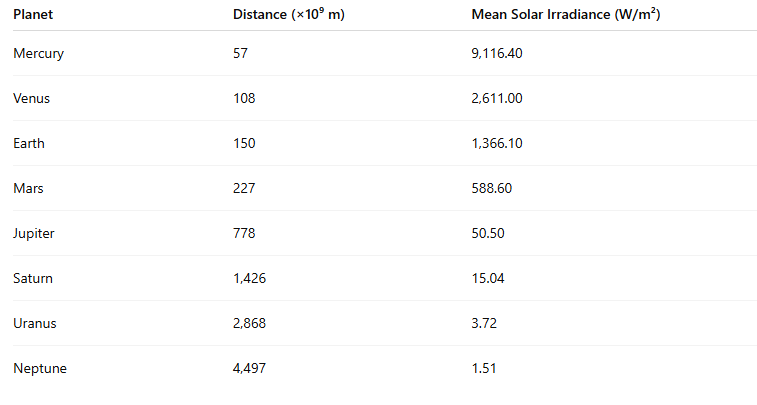
The table indicates the distances of eight planets from the Sun and their meansolar radiances.
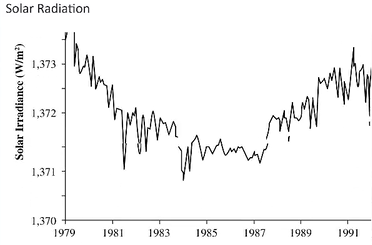
The graph indicates Earth's solar irradiance, as measured by the Nimbus-7 satellite, during the years 1979 through 1991.
In one orbit around the Sun, Earth travels about 939,860,000 km.
How does the solar irradiance of Earth compare to that of a planet that travels about 28,264,000,000 km in one orbit?
Answers
-
correct
-
-
-
Explanation
Correct Answer: A. The solar irradiance of Earth is higher.
Solar irradiance decreases with increasing distance from the Sun according to the inverse-square law (I∝1/r2). Earth travels about 9.40×10^8 km per orbit, which corresponds to an average Sun–Earth distance of 1.50×10^{11} m (1 AU). A planet that travels 2.8264×10^10 km per orbit has an orbital path ~30 times longer, implying an average orbital radius ~30 AU—far beyond Neptune. Because irradiance falls with the square of distance, a world at ~30 AU would receive roughly 1/30^2≈1/900 of Earth’s solar input. The table reflects this pattern: Neptune (farther than Earth) receives only ~1.51 W/m² compared with Earth’s ~1366 W/m². Therefore, Earth’s solar irradiance is much higher than that of a planet taking such a long, distant orbit. Seasonal effects do not reverse this relationship; they modulate irradiance slightly around each planet’s much larger, distance-driven baseline.
Why Other Options are Incorrect:
-
B. The solar irradiance of Earth is lower.
A farther orbital radius yields less flux, not more. A ~30-AU planet must receive far less irradiance than Earth. -
C. The solar irradiance of Earth is the same.
Equality would require equal Sun–planet distances. The orbital circumference given is vastly larger, so distances (and irradiances) cannot match. -
D. The solar irradiance of Earth may be higher or lower depending on the season.
Seasons cause small variations around each planet’s baseline. Earth’s baseline is orders of magnitude higher than a ~30-AU planet; seasonal swings don’t overturn that.