Questionsquestion - HiSET Prep
Question
Breeding Pumpkins
Pumpkin plants are members of the family Cucurbitaceae, which includes a variety of squash and gourd plants. Within that family, the species Cucurbito pepo is generally recognized as the true pumpkin species. Pumpkins can vary in size, color, and other characteristics, depending on the combination of the parent plants' genotypes.
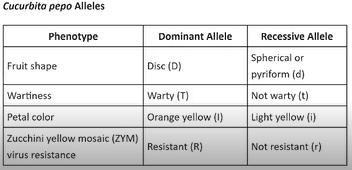
A table of the Cucurbita pepo alleles for four traits is shown.
Researchers observed that the pumpkin plants had climbing vines with large green leaves and bright-yellow flowers. They also observed stoma openings on the underside of the leaves.
Which of the following correctly lists the primary functions of both the flowers and the leaves of the pumpkin plant?
Answers
-
-
-
-
correct
Explanation
Correct Answer: D. Flowers: reproduction, attracting pollinators; leaves: photosynthesis, gas exchange. Flowers are the pumpkin plant’s reproductive organs. They contain stamens (male) and pistils (female) and produce nectar, scent, and showy, bright-yellow petals that attract pollinators such as bees, enabling pollen transfer and fertilization. Leaves are the primary photosynthetic organs; their broad surface area holds many chloroplast-rich mesophyll cells that capture light energy and fix carbon. The observed stomata on the underside of leaves are pores that regulate gas exchange, allowing carbon dioxide to enter for photosynthesis and oxygen and water vapor to exit. Stomatal opening and closing also balance water conservation with metabolic needs. Although petals can photosynthesize minimally, flowers’ central biological role is reproduction, not energy capture. Likewise, leaves do not carry out sexual reproduction, although they support it indirectly by fueling growth. Thus, pairing flowers with reproduction/attraction and leaves with photosynthesis/gas exchange most accurately aligns with plant structure–function relationships observed in cucurbits.
Why Other Options are Incorrect:
-
A. Flowers: photosynthesis, attracting pollinators; leaves: gas exchange, reproduction. Flowers provide only trivial photosynthesis compared with leaves, and leaves are not reproductive organs. Assigning reproduction to leaves misidentifies their role and ignores flowers’ specialized reproductive structures.
-
B. Flowers: gas exchange, attracting pollinators; leaves: photosynthesis, reproduction. Flowers are not primary gas-exchange organs; stomata are abundant on leaves, not petals. Again, assigning reproduction to leaves is inaccurate; sexual structures reside in flowers.
-
C. Flowers: reproduction, photosynthesis; leaves: gas exchange, attracting pollinators. While flowers do reproduction, they are not important photosynthetic organs. Leaves do gas exchange, but they do not attract pollinators; visual and chemical cues for pollinators primarily come from flowers.