


Mathematics education plays a vital role in shaping New Hampshire’s future workforce and preparing students for college and career success. If you’re passionate about numbers and eager to inspire young minds, pursuing a career as a math educator in the Granite State offers rewarding opportunities.
This comprehensive guide walks you through how to become a math teacher in New Hampshire, covering certification requirements, educational pathways, and exam preparation. With Prepsaret providing the best prep test platform for practice questions and answers, you’ll be well-equipped to pass your certification exams.
New Hampshire Teaching Requirements
Before exploring how to become a math teacher in New Hampshire, it’s important to understand the New Hampshire teaching requirements that every aspiring educator must meet. These standards ensure that teachers in the Granite State are well-prepared, knowledgeable, and qualified to guide students effectively.
Core Requirements for Math Teachers in NH
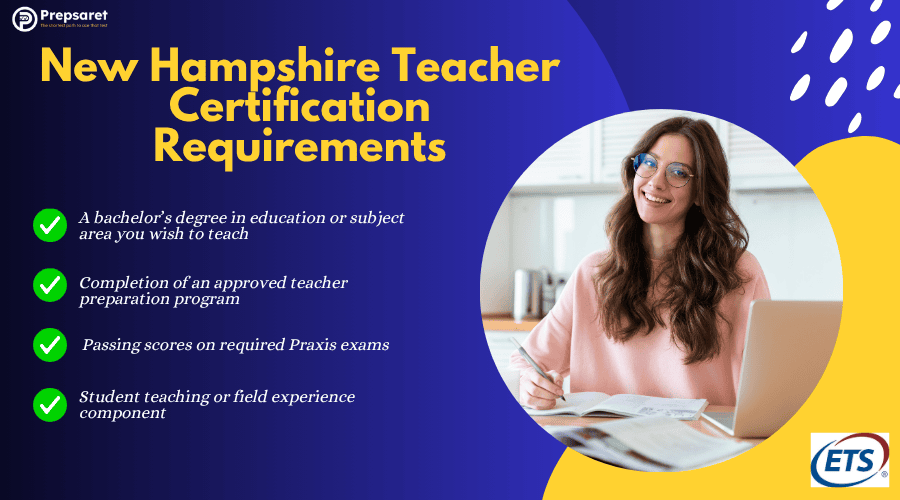
To qualify for math teacher certification New Hampshire, candidates must:
- Earn a bachelor’s degree from an accredited institution
- Complete an approved teacher preparation program
- Pass the required Praxis exams
- Submit a detailed application to the NH Department of Education
- Complete background checks and fingerprinting
- Demonstrate strong content knowledge in mathematics
High School Math Teacher Standards in NH
The requirements for high school math teachers in NH are particularly thorough. Secondary educators must show advanced mastery of math concepts and effective teaching methods. Earning your teaching license in New Hampshire confirms that you’ve met all professional standards and are fully qualified to teach in state-approved schools.
What Degree Do You Need to Teach Math in NH
The foundation of how to become a math teacher in New Hampshire begins with obtaining the right educational credentials. Math education degree requirements vary depending on the grade level you plan to teach, but all paths require solid academic preparation.
Bachelor’s Degree Programs
Most aspiring educators pursue a bachelor’s degree in mathematics education, which blends rigorous math coursework with pedagogical training. Education degree programs in New Hampshire integrate content knowledge with teaching methodology. Core courses typically include:
- Calculus and advanced mathematics
- Educational psychology
- Curriculum design and assessment
- Classroom management techniques
- Differentiated instruction strategies
Alternative Paths
While a mathematics education degree is the most direct route, candidates with degrees in pure mathematics can also qualify by completing additional pedagogical coursework through post-baccalaureate programs.
Can You Teach Math in New Hampshire Without a Degree?
No. All teachers must hold at least a bachelor’s degree. However, the degree does not need to be in education, candidates with strong math backgrounds can pursue alternative certification NH programs to gain teaching credentials.
Best Colleges for Math Education in New Hampshire
Several schools are notable for preparing future math teachers:
- University of New Hampshire: Comprehensive teacher preparation programs with strong math education tracks
- Plymouth State University: Renowned secondary education programs and student teaching opportunities
- Keene State College: Integrated education programs with robust field experiences
- Southern New Hampshire University: Flexible online and on-campus options
These institutions provide the coursework and practical experiences needed to meet state certification requirements. Graduate programs (Master’s degrees) are also available for teachers seeking advanced credentials or specialization in mathematics education.
Teacher Preparation Programs and Clinical Practice
The teacher preparation programs NH institutions offer are designed to transform content knowledge into effective classroom instruction. These programs provide essential hands-on experience through structured clinical practice.
The Role of Student Teaching
The student teaching experience represents a critical component of teacher preparation. During this supervised internship, pre-service teachers:
- Observe experienced mathematics educators
- Gradually assume teaching responsibilities
- Receive mentorship and constructive feedback
- Develop classroom management skills
- Apply pedagogical theory in real-world settings
Student teaching typically occurs during the final year of an undergraduate program and lasts one full semester. This immersive experience allows candidates to practice how to get certified to teach math while working under the guidance of veteran educators.
Mentorship and Professional Development
Teacher preparation programs emphasize collaborative learning through partnerships between universities and local school districts. Mentor teachers provide invaluable insights into curriculum pacing, student engagement strategies, and the realities of daily classroom life.
New Hampshire Teacher Certification Process
Understanding the New Hampshire teacher certification process is crucial for anyone pursuing how to become a math teacher in New Hampshire. The NH Department of Education teacher certification division oversees all credentialing for the state’s educators.
Steps to Become a Teacher in New Hampshire
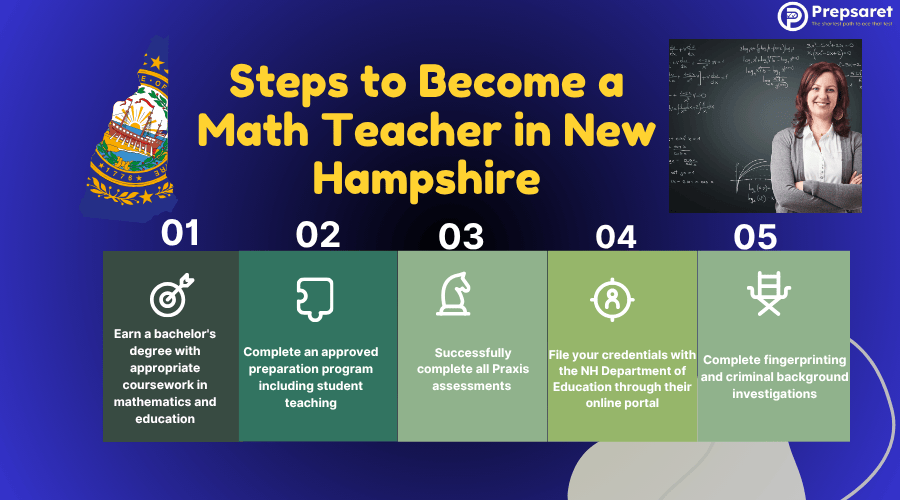
The steps to become a teacher in New Hampshire follow a clear sequence, though timelines vary based on individual circumstances. Here’s the comprehensive pathway:
- Complete Your Education: Earn a bachelor’s degree with appropriate coursework in mathematics and education
- Finish Teacher Preparation: Complete an approved preparation program including student teaching
- Pass Required Exams: Successfully complete all Praxis assessments
- Submit Application: File your credentials with the NH Department of Education through their online portal
- Background Check: Complete fingerprinting and criminal background investigations
- Receive Certification: Upon approval, receive your professional educator license
The steps to get a teaching license in New Hampshire require attention to detail and thorough documentation. Candidates must submit official transcripts, verification of program completion, exam scores, and recommendation letters.
How to Become a Certified Math Teacher in New Hampshire
How to become a certified math teacher in New Hampshire involves demonstrating content mastery through specialized exams and coursework. The state requires mathematics teachers to hold certification appropriate to their teaching level, elementary, middle, or secondary education.
Praxis Exams and Testing Requirements for Math Teachers in NH
All aspiring teachers must pass Praxis exams for teachers to demonstrate both general pedagogical knowledge and subject-specific expertise. For math educators, these assessments verify your readiness for classroom instruction.
Required Praxis Assessments for NH Math Teachers
Mathematics teachers in New Hampshire typically must pass:
- Praxis Core Academic Skills: Tests basic competency in
(sometimes waived based on SAT/ACT scores)
- Praxis Subject Assessment: Mathematics content knowledge test appropriate to your certification level
- Praxis Principles of Learning and Teaching: Evaluates pedagogical understanding
For candidates interested in becoming a high school math teacher, the content knowledge exam covers advanced topics including calculus, statistics, and mathematical reasoning. Secondary education certification requires higher content mastery than elementary certification.
Preparing for Praxis Exams in NH With Prepsaret
The student teaching experience and dedicated preparation are key to success. Using targeted resources, such as Prepsaret, helps candidates review content and pedagogical strategies, boosting confidence and pass rates for NH teachers seeking certification.
Alternative Pathways to Teaching Mathematics in NH
Not every aspiring educator follows the traditional undergraduate route. Alternative teacher certification NH options provide flexible pathways for career changers and individuals with non-education degrees.
Alternative Certification Programs for NH Math Teachers
New Hampshire alternative certification for math teachers allows professionals with strong mathematics backgrounds to enter education through accelerated programs. Typical requirements include:
- Holding a bachelor’s degree with significant mathematics coursework
- Completing abbreviated pedagogical training
- Working under supervision while completing certification requirements
- Passing all required Praxis exams for teachers
Statement of Eligibility
The Statement of Eligibility NH serves as a transitional credential for candidates pursuing alternative certification. It allows individuals to teach while completing remaining requirements under district supervision.
These programs support pathways to teaching mathematics in New Hampshire, accommodate working professionals, and help address teacher shortages through diverse teaching career pathways.
Teacher License Reciprocity in New Hampshire
Teachers certified in other states can transfer their credentials through New Hampshire teaching license reciprocity agreements. The state participates in the NASDTEC Interstate Agreement, which simplifies the credential transfer process.
NH Teacher Reciprocity Agreements
The teacher reciprocity agreements New Hampshire maintains allow qualified out-of-state educators to obtain licensure without repeating their entire preparation program. Candidates must still:
- Hold a valid, current teaching license from another state
- Meet New Hampshire’s basic requirements
- Pass any exams not completed in their original state
- Submit verification of their credentials
Credential Verification via NH Educator Lookup System
The NH educator credential lookup system enables verification of a teacher’s licensure status online. This transparent tool helps districts confirm qualifications and maintain public trust. Candidates can search by name or license number through the NH DOE website to access credential information.
How to Maintain Your Professional Educator License in NH
After earning your professional educator license, ongoing development ensures your credentials remain current. The NH DOE Certification division requires regular renewal so teachers stay up-to-date with best practices.
Continuing Education and Renewal Requirements for NH Teachers
Continuing education for teachers in New Hampshire helps maintain instructional quality. Licensed educators must complete professional development and apply for renewal every five years, including:
- Completion of approved professional development hours
- Evidence of current teaching practice or equivalent professional work
- Updated background checks
- Payment of renewal fees
Teachers may fulfill these requirements through university courses, district workshops, online learning, or professional conferences. The NH DOE critical shortage list highlights high-need areas where educators may access additional support and incentives.
Administrative Updates
Life changes sometimes require credential updates. The NH DOE name Change form allows teachers to update their license after marriage, divorce, or legal name changes, ensuring records remain accurate and communication with the state is seamless.
Salary and Career Outlook for NH Mathematics Educators

Understanding compensation helps plan your teaching career. The salary of math teachers in New Hampshire varies by experience, education, and district location.
Compensation Ranges by Experience Level
NH teachers typically earn competitive salaries compared to neighboring states:
- Entry-level positions: $40,000–$48,000 annually
- Mid-career educators: $50,000–$65,000 annually
- Experienced teachers: $65,000–$80,000+ annually
Advanced degrees, National Board Certification, or leadership roles can increase earning potential. Districts in southern New Hampshire, near Boston, often offer higher salaries to attract qualified candidates.
Job Market Demand for NH Math Teachers
Mathematics is consistently listed as a high-need subject, giving strong demand for qualified NH teachers. Secondary educators, particularly those teaching AP Calculus and Statistics, are especially sought after.
Retirement and enrollment growth ensure steady opportunities, making math teaching a stable and rewarding career path in the state.
How Long Does it Take to Become a Math Teacher in New Hampshire
The timeline varies depending on whether you follow a traditional or alternative pathway.
Traditional Route Timeline
For students entering college with the goal of teaching mathematics:
- Bachelor’s degree: 4 years
- Student teaching experience: Included in final year
- Testing and application: 2–4 months after graduation
Total time: Approximately 4–5 years from high school graduation to a licensed teacher.
Alternative Certification Timeline
Career changers with existing degrees can follow a compressed schedule:
- Alternative teacher certification NH program: 1–2 years
- Praxis exams for teachers: Concurrent with coursework
- Statement of Eligibility NH: May allow teaching while completing remaining requirements
Total time: 1–3 years depending on prior coursework and experience
How to Become a Math Teacher in New Hampshire Online
Modern technology makes how to become a math teacher in New Hampshire online flexible and accessible for students and working professionals.
Online Teacher Education Programs for Math Certification
Many schools offer education degree programs online with:
- Virtual coursework in pedagogy and math content
- Local hybrid student teaching experiences
- Video observations and digital portfolios
Hybrid Approaches Combining Online and In-Person Training
Some in-person components, like student teaching experience, ensure practical training. Online programs benefit career changers, working parents, and rural students seeking flexible learning options.
How to Become a Math Teacher in New Hampshire: FAQs
How Long Does it Take to Get a Teaching License in NH?
Traditional routes take about 4–5 years. Alternative certification for career changers usually takes 1–3 years, depending on prior education, with application processing taking 2–4 months after requirements are met.
Can I Become a Math Teacher Without a Math Degree in New Hampshire?
Yes. Alternative certification programs allow candidates with a bachelor's degree in another field, sufficient math coursework, and pedagogical training to become licensed after passing the required Praxis exams.
How to Become a Teacher in New Hampshire Without a Teaching Degree?
Complete an alternative certification program, pass required Praxis exams, and obtain a Statement of Eligibility if needed, which allows you to teach while finishing the certification requirements under district supervision.
What Is the Minimum Qualification for a Math Teacher in New Hampshire?
A bachelor's degree, completion of a teacher preparation program, passing all required Praxis exams, and successful application for a professional educator license through the NH Department of Education.
How to Become a Math Teacher in New Hampshire: Conclusion
Pursuing how to become a math teacher in New Hampshire opens doors to a fulfilling career shaping young minds and strengthening communities. Whether you choose traditional university preparation or alternative certification, the pathway requires dedication to both mathematics content and pedagogical excellence.
Remember that Prepsaret offers unmatched test preparation resources to help you succeed on certification exams. With proper planning and commitment, you’ll soon join New Hampshire’s community of dedicated educators.