


Montana’s education system urgently needs qualified Mathematics educators to fill growing classroom vacancies. If you’re considering a rewarding career shaping young minds, understanding how to become a Math teacher in Montana opens doors to stable employment with competitive benefits.
This comprehensive guide walks you through every requirement, from degree programs to certification. Before diving into your teaching journey, platforms like Prepsaret offer essential prep materials to help you ace required exams with real practice questions.
Why Montana Needs More Math Teachers
Montana continues to face a statewide shortage of qualified Math educators, particularly in rural and underserved areas. This growing demand has opened excellent opportunities for individuals pursuing Montana education jobs in Mathematics across cities like Billings, Missoula, and smaller communities.
The need for Math teachers is driven by:
- Retiring educators leaving the profession
- Increased focus on STEM instruction
- Expanding student enrollment in some regions
- Limited availability of specialized Math instructors
To meet Montana public school teaching requirements, schools seek candidates with strong Mathematical backgrounds, communication skills, and a genuine passion for student success. High school Math teacher qualifications go beyond mastering formulas, they include creativity, patience, and cultural awareness to engage learners from diverse communities across the state.
What Degree Do You Need to Teach Math in Montana?

Can I teach Math in Montana without a teaching degree? To qualify for Math teaching roles, you must earn at least a bachelor’s degree in Mathematics education or a related field from an accredited institution. Most candidates follow one of two main paths:
- Option 1: Mathematics Education Degree: A Math education degree Montana program blends Mathematical theory with teaching practice. Coursework typically includes advanced Math, educational psychology, lesson planning, and a supervised student-teaching experience.
- Option 2: Mathematics Degree + Teacher Preparation: Alternatively, you can earn a Mathematics degree first, then complete an approved teacher preparation program Montana to gain licensure eligibility.
The Montana Office of Public Instruction (OPI) oversees teacher credentialing and program approval. A Montana state university teaching certificate program ensures that candidates meet all Montana teacher licensure requirements and receive the practical training needed to succeed in the classroom.
Teacher Preparation Programs in Montana
Teacher preparation programs Montana are approved by the Montana Office of Public Instruction (OPI) to ensure high-quality training for future educators. These programs combine academic study with practical classroom experience, preparing candidates for successful teaching certification in Montana.
Core components include:
- Content mastery in key Mathematical areas
- Pedagogical training focused on Math instruction methods
- Field experience through supervised student teaching
- Technology integration for modern classroom engagement
Earning Montana Math teacher certification requires:
- Completing an approved educator preparation program,
- Maintaining a minimum 2.75 GPA in Math-related coursework,
- Passing all required assessments, and
- Fulfilling background check requirements.
Steps to Get a Montana Teaching License
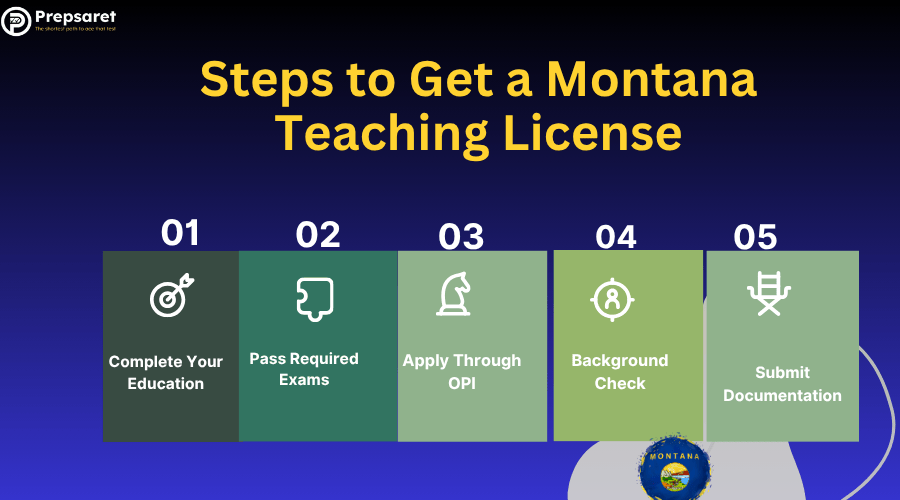
Understanding the steps to get a Montana teaching license helps you navigate the certification process efficiently. Here’s your comprehensive roadmap:
- Step 1: Complete Your Education: Finish your bachelor’s degree with appropriate Mathematics coursework and approved teacher preparation program components.
- Step 2: Pass Required Exams: Successfully complete all required assessments (detailed in the next section).
- Step 3: Apply Through OPI: Submit your application through the OPI educator licensure system, Montana’s official online portal for educator licensing.
- Step 4: Background Check: Complete fingerprinting and pass criminal background investigation.
- Step 5: Submit Documentation: Provide official transcripts, exam scores, program completion verification, and recommendation letters.
How to get certified to teach in Montana involves careful attention to deadlines and documentation requirements. The Montana teaching license application requires:
- Completed application form
- Application fee (currently $100)
- Official transcripts from all institutions attended
- Verification of program completion from your preparation program
- Test scores sent directly from testing agencies
- Three professional references
- Proof of U.S. citizenship or legal work authorization
Processing typically takes 4-6 weeks once complete applications are received. The OPI educator licensure system allows tracking application status online and provides notifications when additional documentation is needed.
Praxis and Testing Requirements for Montana Math Teachers
Praxis exam Montana requirements are critical components of teacher certification. Montana requires specific assessments demonstrating both content knowledge and teaching proficiency.
Required Assessments Include:
Praxis Core Academic Skills for Educators (or qualifying ACT/SAT scores):
Praxis Subject Assessments:
- Mathematics: Content Knowledge (for secondary endorsement)
- Middle School Mathematics (for middle grades endorsement)
Requirements for becoming a high school Math teacher in Montana include achieving minimum passing scores on relevant Praxis exams. Current passing scores are:
- Praxis Mathematics Content Knowledge (5161): 160
- Praxis Middle School Mathematics (5164): 165
Candidates may take these exams before or after completing their degree. Understanding test expectations early ensures you’re fully prepared to meet Montana’s standards for certification.
Registration occurs through the ETS Praxis website, with testing available at multiple Montana locations and many out-of-state centers. Scores remain valid indefinitely, though OPI may update requirements periodically.
Alternative Teacher Certification Pathways in Montana
Wondering how to become a Math teacher in Montana without following traditional routes? Several alternative pathways accommodate career-changers and those with non-traditional backgrounds.
- Alternative teacher certification Montana programs: Allow individuals with a bachelor’s degree in Mathematics or a related field to begin teaching while completing accelerated pedagogy coursework. These programs typically involve teaching under a provisional Class 5 license while fulfilling certification requirements through approved institutions.
- Teacher reciprocity Montana: For licensed educators relocating from other states, teacher reciprocity Montana simplifies the process. The Montana teacher certification process for out-of-state applicants requires:
- Valid teaching license from another state
- Meeting Montana’s testing requirements
- Background checks
- Application through OPI
These routes provide efficient, approved pathways to licensure for qualified professionals ready to bring their Math expertise to Montana classrooms.
Read more: State by State Praxis Requirements
How to Become a Math Teacher in Montana Online

With growing digital learning options, many aspiring educators now explore how to become a Math teacher in Montana online through flexible distance and hybrid programs. These pathways allow you to complete coursework remotely while fulfilling in-person teaching requirements.
Benefits of Online Programs
- Flexible scheduling for working professionals
- Reduced need for relocation
- Self-paced learning options
- Access to virtual collaboration and digital teaching tools
While coursework may be completed online, all candidates must complete supervised student teaching in a classroom setting.
The demand for online teaching jobs Montana has grown, creating new opportunities for licensed educators. Many MT teaching programs now combine online instruction with field experiences, providing a balanced and accessible route to licensure.
Additionally, continuing education for teachers is widely available online, supporting professional growth and license renewal throughout your career.
Teaching Endorsements in Montana
Teaching endorsements in Montana define the subjects and grade levels you’re authorized to teach. Your Montana teaching credential lists these endorsements, which are determined by your education and exam results.
Common Mathematics Endorsements Include:
- Broad Field Mathematics (5–12): Covers all secondary-level Math courses
- Middle Grades Mathematics (5–8): Focuses on middle school Math instruction
- Elementary (K–8): Includes teaching Mathematics along with other core subjects
Educators can expand their credentials by completing additional coursework, passing the required Praxis exams, and applying through the Montana Office of Public Instruction (OPI). Adding endorsements increases versatility and career opportunities across Montana’s school systems.
Salary Expectations and Job Outlook for Math Teachers in Montana
Math teacher salary in Montana varies by location, experience, and educational attainment. Understanding compensation helps you make informed career decisions.
How Much Do Math Teachers Make in Montana?
Average salary ranges (2024-2025):
- Starting Teachers: $35,000 – $42,000 annually
- Mid-Career (5-10 years): $45,000 – $55,000 annually
- Experienced Teachers (15+ years): $55,000 – $68,000 annually
Urban districts like Billings, Missoula, and Great Falls generally offer higher salaries, while rural areas may include benefits like housing assistance or student loan forgiveness.
Montana education jobs in Mathematics remain stable, with strong demand due to ongoing teacher shortages. Additional benefits often include:
- Comprehensive health insurance
- Retirement pension plans through Montana Teachers’ Retirement System
- Generous paid time off (summers, holidays, breaks)
- Professional development funding
- Tuition reimbursement for advanced degrees
Many districts also offer stipends for extracurricular involvement, creating further earning potential for dedicated educators.
How to Become a Math Teacher in Montana vs Other States
Comparing how to become a Math teacher in Montana with other states reveals both similarities and unique characteristics. Montana’s certification process aligns with national standards while maintaining specific state requirements.
Key Comparisons
- Reciprocity: Montana recognizes many out-of-state licenses, making transfers easier than some states
- Testing: Montana’s Praxis requirements are similar to many Western states
- Salaries: Montana salaries are moderate compared to coastal states but competitive within the Mountain West region
- Rural Opportunities: Montana offers more rural teaching positions than many states
Insights From Educators
Teachers discussing how to become a Math teacher in Montana reddit forums often highlight the state’s:
- Supportive teaching communities
- Strong work-life balance
- Outdoor recreation opportunities
- Smaller class sizes in many districts
- Less bureaucracy than larger urban states
Teacher reciprocity Montana policies make the state attractive for educators seeking lifestyle changes while maintaining careers. The straightforward reciprocity process helps experienced teachers transition smoothly.
How Long Does It Take to Become a Math Teacher in Montana?
The timeline varies based on your starting point and chosen pathway.
Traditional Four-Year Path:
- Years 1–3: Complete a bachelor’s degree in Mathematics education and related coursework.
- Year 4: Finish student teaching and required exams.
- Licensure: Apply through the OPI educator licensure system, typically within 1–3 months.
Total Time: About 4–5 years from high school graduation.
Alternative or Career-Change Path:
For candidates entering through alternative teacher certification Montana, the process generally takes 1.5–3 years after earning a bachelor’s degree.
Factors Affecting Your Timeline
- Full-time versus part-time enrollment
- Transfer credits from previous institutions
- Time needed to pass required exams
- Application processing times
Planning ahead and understanding requirements helps you complete the process efficiently.
How to Apply for Montana Teacher Certification Online
How to apply for Montana teacher certification online through the OPI system is straightforward when you follow proper procedures.
- Step 1: Create Your MCIS Account – Visit the Montana comprehensive Information system (MCIS) on the OPI website and create your educator profile with accurate contact details.
- Step 2: Select Application Type – Choose initial teaching license or another category that fits your situation.
- Step 3: Complete Application Sections – Fill in personal information, educational background, work history, references, and criminal history disclosure.
- Step 4: Upload Required Documents – Attach scanned transcripts, program completion verification, Praxis test score reports, and proof of identity.
- Step 5: Pay Application Fee – Submit the $100 payment electronically for initial license applications.
- Step 6: Request Official Documents – Have official transcripts sent directly to OPI, Praxis scores sent from ETS, and your program submit completion verification.
- Step 7: Track Application Status – Log in to your MCIS account to monitor progress; OPI may request additional materials during review.
- Step 8: Complete Background Check – Schedule fingerprinting and complete the required background investigation.
- Step 9: Receive License – Once approved, download your teaching license through your MCIS account. Physical copies are no longer issued, so keep online versions for verification.
The online application system operates 24/7, allowing submission at your convenience. Most complete applications are processed within 4–6 weeks, depending on the review volume.
Diverse Teaching Roles in Montana
Beyond Mathematics instruction, Montana education jobs include a wide range of subjects and specializations, offering excellent career flexibility. PE teaching jobs in Montana require separate physical education endorsements but follow similar certification procedures.
Many schools prefer teachers with multiple subject qualifications, making dual endorsements especially valuable. Similarly, German teaching jobs Montana and other world language positions show that teacher shortages extend beyond STEM areas.
While this guide focuses on Mathematics, the certification process remains similar, only the subject content and Praxis exams differ.
Rural districts often seek multi-endorsed educators who can teach across disciplines, creating strong demand for flexible teachers. Adding endorsements throughout your career can significantly expand your teaching opportunities in Montana.
How to Become a Math Teacher in Montana: FAQs
What Qualifications Do I Need to Teach Maths?
You need a bachelor's degree (preferably in Mathematics or Mathematics education), completion of an approved teacher preparation program, passing scores on Praxis Core and Mathematics Content Knowledge exams, student teaching experience, and Montana teaching licensure through OPI.
Can I Become a Math Teacher Without a Math Degree?
Yes, though it's more challenging. You need a bachelor's degree in any field with sufficient Mathematics coursework, completion of a post-baccalaureate teacher preparation program, and successful Praxis exam results demonstrating Mathematics content mastery.
How Long Does it Take to Become a Teacher in Montana?
Traditional paths require 4-5 years (bachelor's degree plus licensure). Alternative routes for those with existing degrees take 1.5-3 years. Post-baccalaureate programs require 1.5-2 years beyond your bachelor's degree, depending on full-time or part-time enrollment.
What Is a Teacher's Salary in Montana?
Starting teachers earn $35,000-$42,000 annually. Mid-career teachers (5-10 years) make $45,000-$55,000, while experienced teachers (15+ years) earn $55,000-$68,000.
How to Become a Math Teacher in Montana: Conclusion
Understanding how to become a Math teacher in Montana empowers you to pursue this rewarding career with confidence. From earning appropriate degrees through accredited programs to navigating OPI’s certification system, each step brings you closer to shaping young Mathematicians.
Montana’s teacher shortage creates abundant opportunities for qualified candidates. Before taking required exams, visit Prepsaret for comprehensive practice materials featuring actual exam-style questions that ensure you’re thoroughly prepared for success.