


Are you passionate about mathematics and education? How to become a math teacher in Massachusetts involves several key steps, from earning the right degree to passing certification exams.
This comprehensive guide walks you through every requirement, timeline, and pathway to launch your teaching career in the Bay State.
Whether you’re a recent graduate or considering a career change, Prepsaret offers the prep materials you need to ace your licensing exams and achieve your teaching goals.
Overview of Math Teaching in Massachusetts
Massachusetts consistently ranks among the top states for education quality, creating excellent opportunities for qualified educators. The demand for teaching jobs in Massachusetts remains strong, particularly in STEM fields like mathematics.
Current Job Market and Salary for Math Teachers in MA
The teacher salary in Massachusetts is competitive compared to national averages. According to recent data, math teachers in MA earn between $50,000 to $95,000 annually, depending on experience, education level, and district.
Urban districts like Boston and Cambridge typically offer higher compensation packages.
Public vs Private Schools Teaching in MA
Understanding public vs private school teaching Massachusetts options helps you make informed career decisions:
- Public schools require state licensure, offer union benefits, and follow standardized curricula
- Private schools may have flexible certification requirements but often provide smaller class sizes
- Both sectors value strong mathematical knowledge and effective teaching skills
- Public school positions generally offer more job security and comprehensive benefits
The Massachusetts public school system serves over 950,000 students across 400+ districts, providing numerous employment opportunities for qualified math educators.
What Degree Do You Need to Teach Math in Massachusetts
The math teacher degree requirements vary by teaching level and career path. Most candidates follow one of two main routes:
Option 1: Bachelor’s in Mathematics
- Strong foundation in calculus, algebra, geometry, and statistics
- Requires completion of a teacher preparation program Massachusetts or related coursework
Option 2: Bachelor’s in Education with a Math Focus
- Combines pedagogy, content mastery, and classroom experience
- Meets teaching credentials in Massachusetts standards
Key Academic Components for MA Math Teacher Degree
Regardless of which path you choose, your degree should include:
- Minimum 30 credit hours in mathematics
- Child development and educational psychology courses
- Classroom management training
- Technology integration for education
A Bachelor’s in education or mathematics provides the foundation, but you’ll also need to complete additional teaching credentials in Massachusetts through approved preparation programs.
Teacher Preparation Program in Massachusetts
After earning your bachelor’s degree, enrolling in a teacher preparation program Massachusetts is essential for gaining practical experience and meeting licensure requirements.
Structure of Approved Teacher Preparation Program in MA
Massachusetts offers numerous approved preparation programs through universities and colleges. These Massachusetts teacher preparation programs typically include:
- Supervised Practicum: 150+ hours of pre-practicum experience
- Student Teaching: Full semester of supervised classroom teaching
- Methods Courses: Subject-specific pedagogy for mathematics instruction
- Assessment Training: Learning to evaluate student progress effectively
Traditional vs Online Teacher Preparation Programs in MA
The state recognizes both on-campus and online teacher preparation programs Massachusetts as long as they’re accredited. A quality teacher preparation program MA should prepare you for real classroom challenges while meeting state standards.
Many programs partner with local school districts, providing valuable networking opportunities and potential job placements after graduation. When selecting a program, consider factors like location, schedule flexibility, and specialization options for middle or high school mathematics.
Massachusetts Teaching License Requirements

Understanding Massachusetts teaching license requirements is crucial for planning your career path. The state’s Department of Elementary and Secondary Education (DESE) oversees all educator licensing.
Initial License Prerequisites for Massachusetts Educators
To obtain your Massachusetts educator license, you must:
- Complete an approved educator preparation program
- Pass required MTEL examinations (discussed in the next section)
- Submit fingerprint-based background check
- Provide official transcripts showing bachelor’s degree completion
- Pay application fees (currently $100 for initial license)
Massachusetts License Types and Levels
The Massachusetts Department of Education teacher certification system includes several license categories:
- Initial License: Valid for 5 years, requires completion of induction program
- Professional License: Renewable every 5 years, requires additional professional development
- Preliminary License: For career changers through alternative programs
Teaching Experience Requirements for Initial License
The teaching experience requirements vary by license type. Initial license holders must complete a one-year induction program with an experienced mentor teacher. This supervised experience ensures new educators receive support during their critical first year.
Massachusetts Tests for Educator Licensure (MTEL)
The Massachusetts tests for educator licensure are standardized exams required for teacher certification. Every candidate must pass the MTEL (Massachusetts Tests for Educator Licensure) before receiving their license.
Required MTEL Exams for Math Teachers
To become certified, you’ll need to pass:
Communication and Literacy Skills Test
- Reading comprehension
- Written expression
- 4-hour computer-based exam
Mathematics Subject Test
- Content knowledge appropriate to your teaching level
- Different versions for middle school and high school
Middle School vs High School Teacher Certification in MA
The requirements for middle school math teachers in Massachusetts differ from high school requirements:
- Middle School (5-8): Mathematics (47) subtest
- High School (8-12): Mathematics (09) subtest, covering advanced topics
The high school math teacher certification process MA includes more rigorous mathematical content, including calculus, trigonometry, and advanced statistics.
MTEL Preparation Strategies
Success on these exams requires thorough preparation. Prepsaret provides comprehensive Praxis prep materials with exact practice questions and detailed answer explanations, helping you pass on your first attempt. The platform offers:
- Full-length practice exams
- Subject-specific study guides
- Performance tracking tools
- Expert test-taking strategies
Register for the MTEL through the Pearson VUE website at least 6 weeks before your desired test date to ensure availability.
Alternative Teacher Certification Pathways in Massachusetts
Not everyone follows the traditional education degree route. Massachusetts teacher certification programs include various pathways designed for different backgrounds and career stages.
Traditional Teacher Certification Route in MA
The conventional path involves completing a bachelor’s degree in education or mathematics, followed by an approved preparation program. This route works well for students who know early they want to teach.
Alternative Teacher Certification Routes in MA
Wondering how to become a teacher in MA without an education degree?Alternative teacher certification MA options serve career changers and professionals with strong subject knowledge.
Massachusetts Transition to Teaching Program
- For individuals holding bachelor’s degrees in mathematics or related fields
- Combines coursework with paid teaching positions
- Typically completed in 1-2 years
License Based on Another State’s License
Teachers certified elsewhere can apply for Massachusetts licensure, often requiring limited Massachusetts teaching license requirements adjustments.
How to Switch Careers to Teaching Math in MA
Professionals with math-related degree (engineering, statistics, computer science), the Massachusetts alternative teacher licensure for math provides an accelerated pathway:
- Enroll in an alternative preparation program
- Complete subject-specific pedagogy training
- Pass MTEL examinations
- Gain supervised teaching experience
These programs recognize your existing expertise while ensuring you develop essential teaching skills. Many districts actively recruit career changers, especially in high-demand subjects like mathematics.
How to Become a Math Teacher in Massachusetts Online
Modern learning has transformed teacher education. How to become a math teacher in Massachusetts online is now a viable option for many aspiring educators.
Massachusetts Institutions Offering Online Degree Programs
Several Massachusetts institutions offer fully online or hybrid bachelor’s and master’s programs in education with mathematics specialization. These programs provide flexibility for working professionals or those with family obligations.
Online Preparation Programs in MA
Many approved teacher preparation programs now offer online components, allowing you to complete coursework remotely while fulfilling practicum requirements locally. Look for programs that:
- Hold regional accreditation
- Are approved by Massachusetts DESE
- Offer strong student support services
- Provide help securing local placements for field experiences
Post-Baccalaureate Online Programs for Math Teacher Certification
Wondering how to become a math teacher in Massachusetts after earning your bachelor’s degree in mathematics? Online post-baccalaureate programs bridge the gap between your math degree and teaching certification without requiring campus attendance.
How Prepsaret Support Online Praxis Exam Preparation
Prepsaret offers comprehensive online test preparation for all MTEL examinations. The platform’s interactive features help you study efficiently from anywhere, with practice tests that mirror actual exam formats and difficulty levels.
How to Get a Math Teaching License in Massachusetts
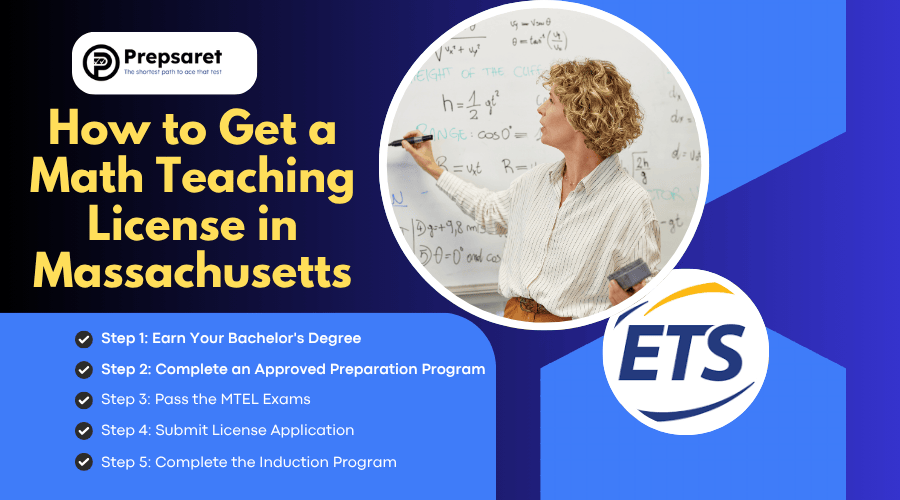
This practical roadmap shows exactly how to get a math teaching license in Massachusetts step by step
Step 1: Earn Your Bachelor’s Degree
Complete a bachelor’s in education or mathematics or a related field with substantial math coursework. Maintain a GPA above 3.0 for competitive program admission.
Step 2: Complete an Approved Preparation Program
Enroll in and finish a teacher preparation program Massachusetts approved by DESE. This includes student teaching and all required coursework.
Step 3: Pass the MTEL Exams
Register for and pass both the Communication and Literacy Skills test and the appropriate math teacher certification Massachusetts subject test. Use Prepsaret‘s targeted prep materials to maximize your chances of first-time success.
Step 4: Submit License Application
Apply through the Massachusetts Educator Licensure system online. You’ll need:
- Official transcripts
- Program completion verification
- MTEL score reports
- Background check results
- Application fee payment
Step 5: Complete the Induction Program
During your first year of teaching under an Initial License, participate in a district-provided induction program with mentor support.
Step 6: Verify Your License Status
Use the MA Teacher license Lookup tool on the DESE website to check your application status and verify your license information once approved.
Continuing Education and Career Growth for MA Teachers
Professional development doesn’t end with certification. Continuing education for teachers keeps your skills current and maintains your Massachusetts educator license.
License Renewal Requirements for MA Teachers
Professional licenses must be renewed every five years. Requirements include:
- 150 Professional Development Points (PDPs)
- Ongoing employment as an educator
- Proof of completed professional development activities
Professional Development Activities for MA Educators
Earning PDPs can include:
- Graduate coursework toward a master’s degree
- District-provided workshops and training
- Professional conferences and seminars
- Curriculum development projects
- Educational research and publication
Career Advancement Opportunities for Math Teachers in MA
Experienced math teachers can pursue:
- Department Chair: Lead the mathematics department
- Instructional Coach: Support other math teachers
- Curriculum Specialist: Design math programs district-wide
- Administration: Become an assistant principal or principal
- Higher Education: Teach at community colleges or universities
Many educators pursue master’s degrees or doctoral programs while teaching, opening doors to leadership roles and higher salaries.
How Long Does It Take to Become a Teacher in Massachusetts?

The timeline varies based on your starting point and chosen pathway.
Traditional Route Timeline
4-5 Years Total
- 4 years: Bachelor’s degree
- 1 semester to 1 year: Teacher preparation program (may overlap with bachelor’s)
- 3-6 months: MTEL testing and application processing
Alternative Route Timeline
1.5-3 Years (if you already hold a bachelor’s degree)
- 1-2 years: Alternative preparation program
- 3-6 months: Testing and licensure application
Accelerated Options
Some intensive programs allow you to complete preparation requirements in as little as one year, particularly if you’re becoming a teacher in MA through alternative certification with strong mathematics credentials.
Keep in mind that while you can obtain your Initial License within these timeframes, developing into a confident, effective educator takes years of classroom experience and ongoing professional growth.
FAQs About How to Become a Math Teacher in Massachusetts
Can I Become a Math Teacher Without a Math Degree?
Yes. You can teach math with a non-math degree if you complete a teacher preparation program, have sufficient math coursework, and pass the required MTEL exams.
Can you Be a Teacher Without a Teaching Degree in Massachusetts?
Yes. Massachusetts allows alternative licensure for candidates with non-education degrees who complete an approved program, pass MTEL exams, and meet state certification requirements.
Do Teachers in Massachusetts Need a Master's Degree?
No. A master’s degree isn’t required but can boost salary, promotion potential, and professional growth. Many districts reward teachers with graduate credentials.
How to Become a Math Teacher in MA?
Earn a bachelor’s degree, complete a teacher preparation program, pass MTEL exams, apply for licensure, and complete an induction program. Traditional routes take about 4–5 years.
How to Become a Math Teacher in Massachusetts: Conclusion
How to become a math teacher in Massachusetts requires dedication, proper preparation, and meeting specific state requirements. From earning your degree to passing the MTEL exams, each step brings you closer to a rewarding career shaping young minds.
Start your journey with confidence using Prepsaret’s comprehensive exam prep materials, your trusted partner for accurate practice questions and expert guidance toward Massachusetts teacher certification success.