


Are you passionate about numbers and shaping young minds? Teaching in Arkansas schools offers a rewarding career with growing opportunities.
The state faces a consistent demand for qualified mathematics educators, making this an ideal time to pursue how to become a math teacher in Arkansas.
Whether you’re a recent graduate or career changer, public school teaching jobs in mathematics offer stability and purpose, and with Prepsaret’s expert prep materials, you can confidently prepare for certification success.
Steps to Become a Teacher in Arkansas
Before diving into specific requirements, let’s map out the journey. Understanding the steps to become a teacher in Arkansas helps you plan effectively and avoid surprises along the way.
The general pathway includes:
- Earning a bachelor’s degree in mathematics, education, or a related field
- Completing an approved teacher preparation program that meets state standards
- Passing required exams including the Praxis Core and Praxis Subject Assessments
- Submitting your application for licensure through the Arkansas Department of Education
- Obtaining your initial teaching license to begin your classroom career
For those exploring how to become a math teacher in Arkansas online, many universities now offer flexible programs that accommodate working professionals.
Additionally, if you’re wondering how to become a teacher in Arkansas without an education degree, the state provides alternative pathways that we’ll explore in detail.
The steps to get a math teaching license in Arkansas may vary based on your educational background, but the core requirements remain consistent.
If you already hold a bachelor’s degree in any field, you can pursue how to become a teacher in Arkansas with a bachelor’s through specialized certification programs designed for career changers.
Math Teacher Education Requirements in Arkansas

Your educational background forms the foundation of your teaching career. The math teacher education requirements in Arkansas are designed to ensure you possess both content knowledge and pedagogical skills.
Degree Requirements to Teach Math in Arkansas
To teach mathematics in Arkansas, you’ll need at minimum:
- A bachelor’s degree from an accredited institution – This is non-negotiable for traditional certification
- Sufficient mathematics coursework – Even if your degree isn’t specifically in math, you’ll need to demonstrate content mastery
- Pedagogical training – Understanding how students learn mathematics is as important as knowing the content itself
When considering what degree do you need to teach math in Arkansas, the most straightforward path involves earning a bachelor’s degree in education with a mathematics concentration.
However, degrees in mathematics, applied mathematics, or related STEM fields also qualify you for teaching, provided you complete the necessary education coursework.
Best Educational Institution for Math Teacher Prep in Arkansas
The best colleges for math teacher preparation in Arkansas include:
- University of Arkansas – Offers comprehensive mathematics education programs with strong student-teaching components
- Arkansas State University – Known for its focus on STEM education and rural teaching preparation
- University of Central Arkansas – Features robust mathematics and secondary education programs
- Henderson State University – Provides personalized attention and excellent field experience opportunities
A teaching degree Arkansas program typically combines mathematics content courses with education methodology, classroom management, and supervised teaching experiences.
These programs align with Arkansas teaching standards to ensure graduates are well-prepared for the classroom.
Teacher Preparation Programs in Arkansas
Completing an approved preparation program is essential for licensure. Teacher preparation programs Arkansas institutions offer are carefully monitored to meet state requirements.
Traditional Teacher Certification Programs
Traditional programs integrate your bachelor’s degree with teacher training. These programs typically span four years and include:
- Mathematics content courses (calculus, algebra, geometry, statistics)
- Educational psychology and child development
- Methods courses specific to teaching mathematics
- Classroom management and instructional strategies
- Student teaching under experienced mentor teachers
Arkansas Professional Educator Pathway (ArPEP)
The Arkansas Professional Educator Pathway (ArPEP) is the state’s framework for educator preparation and licensure. This system ensures all programs meet rigorous standards and prepare candidates according to evidence-based best practices.
ArPEP emphasizes:
- Competency-based preparation rather than simply seat-time requirements
- Clinical experiences that gradually increase in responsibility
- Performance assessments that measure your readiness to teach
- Continuous improvement based on program outcomes and candidate success
All approved programs must align with ArPEP standards, ensuring consistency across institutions while allowing flexibility in program design.
Arkansas Teacher Licensure Requirements
Securing your license is the official gateway to your teaching career. Understanding Arkansas teacher licensure requirements ensures you complete every necessary step.
Core Requirements for Teacher Licensure in Arkansas
The Arkansas teaching license requirements include:
- Completed bachelor’s degree from an occasionally accredited institution
- Approved teacher preparation program or alternative certification route
- Passing scores on all required examinations
- Background check including fingerprinting
- Application submission with appropriate fees
Types of Arkansas Teacher Licenses
Math teacher certification Arkansas comes in several forms:
- Initial Teaching License: This is your first professional license, valid for three years. It’s renewable and represents your entry into the profession. The initial teaching license requires completing all preparation and exam requirements.
- Standard Teaching License: After successfully completing your initial license period and meeting continuing education requirements, you’ll qualify for a standard license that offers longer validity periods.
- Provisional Professional Teaching License Arkansas: This option serves teachers who haven’t completed all traditional requirements but are working toward full licensure while employed in schools.
Arkansas Department of Education Teacher Certification
The Arkansas Department of Education teacher certification process is managed through the Educator Licensure division. They oversee:
- Application processing and verification
- Exam score reporting and tracking
- License renewal and continuing education monitoring
- Reciprocity agreements with other states
Educator licensure in Arkansas follows a competency-based model, meaning you must demonstrate specific skills and knowledge rather than simply completing coursework hours.
Arkansas Teaching License Application Process
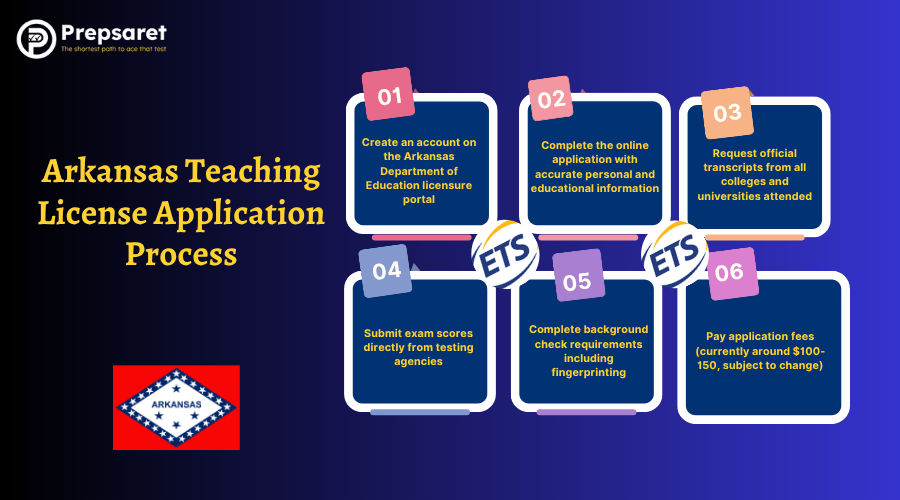
The Arkansas teaching license application process is straightforward when you understand the steps.
- Step 1: Create an account on the Arkansas Department of Education licensure portal
- Step 2: Complete the online application with accurate personal and educational information
- Step 3: Request official transcripts from all colleges and universities attended
- Step 4: Submit exam scores directly from testing agencies
- Step 5: Complete background check requirements including fingerprinting
- Step 6: Pay application fees (currently around $100-150, subject to change)
- Step 7: Monitor application status through the online portal
Processing takes 4-6 weeks once all materials are received. Your Arkansas teaching license will be issued electronically, and you can print copies as needed for employment verification.
For those exploring how to get a teaching certificate in Arkansas without a degree in education, the application process is similar, but you’ll need to provide evidence of completing an alternative certification program and potentially additional documentation of content expertise.
Testing and Exam Requirements for Math Teachers in Arkansas
Examinations verify your content knowledge and teaching readiness. Understanding Arkansas Praxis test requirements helps you prepare effectively.
Required Exams for Math Teachers in Arkansas
- Praxis Core Academic Skills for Educators: This exam assesses basic competency in reading, writing, and mathematics. Some candidates may be exempt based on ACT/SAT scores or previously completed degrees.
- Praxis Subject Assessments: The specific tests depend on the grade level and subject area you plan to teach. The Arkansas Praxis math test requirements typically include:
- Praxis Mathematics: Content Knowledge (5161) for middle school mathematics
- Praxis Mathematics: Content Knowledge (5161) for high school mathematics
- Some positions may require additional exams depending on your specific teaching assignment
How to Prepare for Arkansas Teacher Exams
Arkansas teacher exams are rigorous and require thorough preparation. This is where Prepsaret becomes your secret weapon. As the premier preparation platform for professional certification exams, Prepsaret offers:
- Exact question formats that closely mirror actual Praxis exams
- Comprehensive answer explanations that deepen your understanding
- Practice tests that simulate real testing conditions
- Targeted study materials focused specifically on Arkansas requirements
- Up-to-date content reflecting current exam standards
Many successful Arkansas teachers credit their exam success to Prepsaret‘s focused preparation materials. The platform’s mathematics-specific resources help you identify weak areas and build confidence before test day.
What Are the Requirements to Teach High School Math in Arkansas
High school mathematics positions typically require:
- Higher cut scores on Praxis mathematics exams
- Demonstrated expertise in advanced mathematical concepts
- Strong performance across multiple mathematics domains
Alternative and Provisional Teacher Certification Routes in Arkansas
Not everyone follows the traditional path, and Arkansas recognizes the value of diverse entry points into teaching.
Alternative Teacher Certification Programs in Arkansas
Alternative teacher certification programs serve career changers and those with non-education degrees. These accelerated programs allow you to begin teaching while completing certification requirements.
The alternative route to teacher certification in Arkansas includes:
- Accelerated training during summer months before school begins
- Mentorship programs with experienced educators in your school
- Coursework completion while teaching under a provisional license
- Gradual progression toward full certification while gaining classroom experience
Programs like Teach for America, Arkansas Teacher Corps, and various university-based alternative certification programs provide these pathways.
Provisional Teacher Licensure in Arkansas
The Provisional Professional Teaching License Arkansas allows you to teach while completing remaining requirements. This license is ideal for:
- Career professionals with expertise in mathematics but lacking formal education training
- Teachers relocating from states without reciprocity agreements
- Individuals completing alternative certification programs
Provisional licenses typically last 1-2 years and require you to actively work toward meeting all standard licensure requirements.
Career and Salary Outlook for Math Teachers in Arkansas

Understanding the financial and professional landscape helps you make informed career decisions.
How Much Does a Math Teacher Make in Arkansas?
The Arkansas math teacher salary varies based on several factors:
- Starting salary: Typically ranges from $38,000-$42,000 for first-year teachers
- Experience-based increases: Most districts use salary schedules that reward years of service
- Education level: Teachers with master’s degrees earn higher salaries
- District location: Urban and suburban districts generally offer higher compensation than rural areas
- Additional responsibilities: Department chairs, coaches, and activity sponsors receive stipends
While Arkansas teacher salaries have historically been below national averages, recent legislation has prioritized educator pay increases, making the profession more financially viable.
Teacher Job Market in Arkansas
Public school teaching jobs in mathematics remain consistently available. The demand for qualified math teachers exceeds supply, particularly in:
- Rural school districts
- High-need urban schools
- Middle school mathematics positions
- Secondary STEM-focused programs
This teacher shortage means qualified candidates often have multiple job offers and negotiating leverage. Mathematics teachers enjoy strong job security and advancement opportunities, including department leadership roles and curriculum specialist positions.
Continuing Education and Professional Growth for Math Teachers
Your learning doesn’t stop when you earn your license. Continuing education for teachers ensures you stay current with best practices and maintain licensure.
Professional Development Requirements
Arkansas requires licensed teachers to complete ongoing professional development to renew their licenses. This typically includes:
- Professional learning hours focused on instructional improvement
- Content-specific training in mathematics education
- Technology integration workshops and courses
- Assessment and data analysis training
Growth Opportunities for Math Teacher in Arkansas
Beyond maintaining your license, continuing education opens doors to:
- National Board Certification with accompanying salary increases
- Master’s degrees in mathematics education, curriculum, or educational leadership
- Instructional coaching positions supporting other mathematics teachers
- Administrative roles as assistant principals or principals
- Curriculum development positions at district or state levels
Investing in your professional growth benefits both your career trajectory and your students’ learning outcomes.
Arkansas Reciprocity for Out-of-State Teachers
Already licensed elsewhere? Teacher reciprocity Arkansas provisions may streamline your transition to teaching in the Natural State.
Interstate Agreements
Arkansas participates in the NASDTEC Interstate Agreement, which facilitates license reciprocity with many states. If you hold a valid teaching license from another state, you may qualify for expedited Arkansas licensure.
Requirements for Out-of-State Teachers
To transfer your license, you’ll typically need:
- Valid out-of-state teaching license in good standing
- Comparable preparation to Arkansas requirements
- Passing scores on Arkansas-specific exams (if your state’s exams differ significantly)
- Background check through Arkansas systems
- Application submission with verification from your previous state
Each case is evaluated individually, so contact the Arkansas Department of Education early in your planning process to understand specific requirements.
How Long Does It Take to Become a Math Teacher in Arkansas
The time it takes to become a math teacher in Arkansas varies depending on your education and chosen pathway.
Traditional Route Timeline
- Bachelor’s degree in education: ~4 years
- Exam preparation and testing (meeting Arkansas Praxis test requirements): 2–6 months
- Arkansas teaching license application processing: 4–6 weeks
Total: Around 4–5 years from start to full licensure.
Alternative Route Timeline
For those using an alternative route to teacher certification in Arkansas:
- Initial training: 6–12 weeks
- Provisional Professional Teaching License Arkansas: valid while completing requirements
- Remaining coursework: up to 2 years
Total: Usually 2–3 years for degree holders.
Accelerated Options
Through online or competency-based teacher preparation programs Arkansas, motivated candidates can complete requirements in as little as 18–24 months.
How to Become a Math Teacher in Arkansas: FAQs
How Much Does a Math Teacher Make in Arkansas?
Math teachers in Arkansas earn around $38,000–$42,000 starting, with higher pay for advanced degrees, certifications, and experience. Salaries vary by school district and region.
Can I Become a Math Teacher Without a Math Degree?
Yes. With a related degree and alternative certification programs, you can teach math by passing Praxis math exams and completing required coursework for content mastery.
How Long Does it Take to Get an Arkansas Teaching License?
Typically 4–5 years through traditional programs or 2–3 years via alternative routes. Application processing adds about 4–6 weeks once requirements are complete.
What Is the Quickest Path to Teacher Certification?
Alternative certification programs are fastest, 6–12 weeks of training followed by provisional teaching. Dedicated candidates can earn full licensure within 1–2 years.
How to Become a Math Teacher in Arkansas: Final Thoughts
Embarking on how to become a math teacher in Arkansas is more than a career choice, it’s a commitment to shaping futures and strengthening communities.
With clear requirements, multiple pathways, and growing demand, there’s never been a better time to pursue this rewarding profession.
Prepare thoroughly using resources like Prepsaret for exam success, and take your first step today toward making a difference in Arkansas classrooms.