


How to Become an English Teacher in Connecticut
If you’re passionate about literature, writing, and helping students develop critical reading and communication skills, learning how to become an English teacher in Connecticut is your first step toward a rewarding career in education.
Connecticut maintains rigorous standards for teacher certification, ensuring that every English educator in the state’s public schools is thoroughly prepared to guide students through the complexities of language arts instruction.
This comprehensive guide walks you through every requirement, from choosing the right degree program to passing the necessary Praxis exams and securing your Connecticut teaching license.
Whether you’re a recent college graduate, a career changer, or an out-of-state teacher seeking reciprocity, understanding Connecticut’s specific pathway to English teacher certification will help you navigate the process efficiently and position yourself for success in one of the nation’s highest-paying states for educators.
Understanding Connecticut’s English Teacher Certification Requirements
The Connecticut State Department of Education (CSDE) oversees all teacher certification in the state and sets clear standards for individuals seeking to teach English in public schools. Connecticut requires all prospective teachers to complete an approved educator preparation program, demonstrate content knowledge through standardized testing, and fulfill practical teaching experience requirements before receiving an initial teaching license.
Connecticut offers several certification routes depending on your educational background and career stage:
Traditional Route: Complete a state-approved teacher preparation program at a Connecticut college or university, which includes both coursework and supervised student teaching.
Alternate Route for School Counselors (ARC): Designed for individuals who hold at least a bachelor’s degree in English or a closely related field but did not complete a traditional teacher preparation program.
Out-of-State Certification: Connecticut offers reciprocity options for teachers who hold valid certification from other states, though additional requirements may apply.
The specific license you’ll pursue as an English teacher is the Secondary Education (Grades 7-12) English certification or the Comprehensive English (Grades K-12) certification, depending on the grade levels you wish to teach and the preparation program you complete.
Educational Requirements: Degree and Coursework
Bachelor’s Degree Requirement
To become an English teacher in Connecticut, you must hold at least a bachelor’s degree from a regionally accredited institution. While Connecticut does not mandate that your undergraduate degree specifically be in English or Education, your degree must provide sufficient content knowledge in English language arts to meet certification standards.
Most successful candidates complete one of the following degree paths:
Bachelor of Arts in English: Provides comprehensive coverage of literature, writing, linguistics, and critical theory—the foundational knowledge expected of secondary English teachers.
Bachelor of Science in English Education: Combines English content courses with educational theory and pedagogy, specifically designed for those planning to teach.
Bachelor’s degree in a related field: If your degree is in journalism, communications, creative writing, or comparative literature, you may still qualify, but you’ll need to demonstrate sufficient coursework in English literature and composition.
Required Coursework Areas
Connecticut expects English teacher candidates to have substantial academic preparation across multiple dimensions of English studies:
Literature: American, British, and world literature across historical periods and diverse cultural perspectives
Composition and Rhetoric: Writing theory, composition pedagogy, and advanced writing across genres
Language and Linguistics: English grammar, syntax, semantics, and language development
Literary Analysis and Criticism: Critical approaches to interpreting texts and understanding literary theory
Adolescent Literature: Young adult literature and texts appropriate for secondary students
Multicultural and Diverse Texts: Literature representing diverse voices, cultures, and experiences
If your transcript lacks coursework in any of these areas, you may need to complete additional undergraduate or graduate courses before applying for certification. The Connecticut State Department of Education reviews transcripts carefully to ensure candidates have the breadth of content knowledge necessary for effective English instruction.
Connecticut State-Approved Teacher Preparation Programs
Traditional Teacher Preparation Programs
Connecticut requires completion of a state-approved educator preparation program, which includes both academic coursework in teaching methods and supervised clinical experience in actual classrooms. These programs are offered at colleges and universities throughout Connecticut and are specifically designed to meet CSDE certification standards.
Teacher preparation programs include:
Pedagogical Coursework: Educational psychology, curriculum design, assessment methods, classroom management, and instructional strategies specific to teaching English language arts
Methods Courses: Specialized instruction in teaching reading comprehension, literary analysis, writing instruction, vocabulary development, and differentiation for diverse learners
Clinical Experience: Progressive field experiences beginning with classroom observation and culminating in full-time student teaching under the supervision of a licensed cooperating teacher and university supervisor
Technology Integration: Training in educational technology tools and digital literacy instruction
Special Populations: Coursework addressing English Language Learners (ELLs), students with disabilities, and culturally responsive teaching practices
State-approved programs in Connecticut are offered at institutions including the University of Connecticut, Central Connecticut State University, Southern Connecticut State University, Fairfield University, Quinnipiac University, and several other accredited colleges throughout the state. Each program must be approved by the CSDE and meets consistent standards, though specific course sequences and requirements may vary by institution.
Read on: State by State Praxis requirements
Alternate Route Certification (ARC Program)
For individuals who already hold a bachelor’s degree but did not complete a traditional teacher preparation program, Connecticut offers the Alternate Route for Certification (ARC) program. This pathway allows career changers and individuals with strong content backgrounds to become teachers while completing pedagogical training.
ARC program requirements include:
Eligibility: Hold a bachelor’s degree with a GPA of at least 2.70 and demonstrate appropriate content knowledge through transcripts or Praxis Subject Assessments
Program Components: Enroll in a CSDE-approved ARC program that provides condensed pedagogical training, typically completed in summer intensive sessions followed by coursework during the school year
Teaching Position: Secure employment in a Connecticut public school under an initial educator certificate or transitional certification while completing the program
Mentorship: Receive ongoing support from an experienced mentor teacher and program coordinator
Completion Requirements: Successfully complete all program requirements, including coursework, performance assessments, and teaching evaluations
The ARC program typically takes 1-2 years to complete while you’re actively teaching in a Connecticut school. This pathway is particularly popular among professionals with English degrees who are transitioning from careers in writing, publishing, journalism, or other fields.
Student Teaching Requirements
Student teaching represents the capstone clinical experience in Connecticut’s traditional teacher preparation programs and is essential for developing the practical skills necessary for effective classroom instruction. Connecticut requires a substantial period of full-time supervised student teaching, typically lasting one full semester (approximately 12-16 weeks).
Student Teaching Components
Cooperating Teacher Supervision: You’ll be placed with an experienced, licensed English teacher in a Connecticut secondary school who serves as your mentor and daily supervisor
University Supervisor: A faculty member from your preparation program conducts regular observations, provides feedback, and evaluates your teaching performance
Gradual Release of Responsibility: Student teaching typically follows a progressive model where you begin by observing, then teach individual lessons, small groups, and eventually assume full responsibility for all classes
Diverse Placements: Many programs require placements in schools serving diverse student populations to ensure you gain experience with varied learning needs, cultural backgrounds, and ability levels
Performance Assessment: Your teaching is evaluated using standardized rubrics aligned with Connecticut’s Common Core of Teaching standards, focusing on planning, instruction, assessment, professional responsibility, and continuous improvement
What Student Teaching Involves
During your student teaching semester, you’ll engage in all aspects of a professional English teacher’s responsibilities:
- Planning and delivering full units of instruction in reading, writing, speaking, and listening
- Differentiating instruction for students with diverse needs, including ELLs and students with IEPs
- Assessing student work, providing feedback, and using assessment data to inform instruction
- Managing classroom behavior and creating a positive learning environment
- Communicating with students, parents, and colleagues
- Participating in faculty meetings, professional development, and school activities
- Reflecting on your teaching practice and implementing feedback from supervisors
Student teaching is demanding but transformative. It provides the hands-on experience that transforms theoretical knowledge into practical teaching skill and is consistently cited by new teachers as the most valuable component of their preparation.
Required Praxis Exams for Connecticut English Teachers
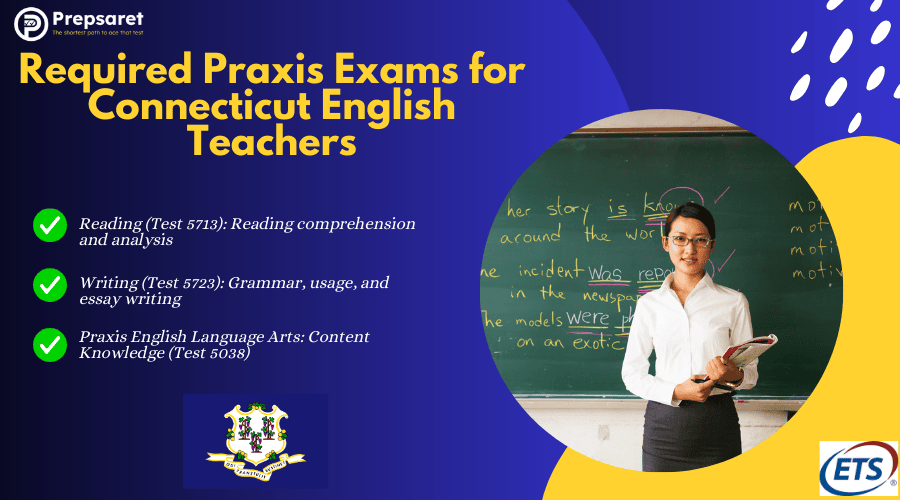
Connecticut requires all teacher candidates to demonstrate content knowledge and pedagogical skills through standardized assessments administered by the Educational Testing Service (ETS). For English teachers, you must pass specific Praxis exams before receiving your initial teaching license.
Praxis Core Academic Skills for Educators
While Connecticut does not universally require the Praxis Core Academic Skills for Educators tests for all candidates, some teacher preparation programs may require these assessments for admission or as a prerequisite to student teaching. The Praxis Core assesses basic skills in:
- Reading (Test 5713): Reading comprehension and analysis
- Writing (Test 5723): Grammar, usage, and essay writing
- Mathematics (Test 5733): Basic mathematical concepts and problem-solving
If you hold a bachelor’s degree with a GPA of 3.0 or higher, many programs waive the Praxis Core requirement. Check with your specific preparation program to determine whether you need to take these tests.
Praxis Subject Assessments for English Teachers
Connecticut requires all English teacher candidates to pass a Praxis Subject Assessment demonstrating content knowledge in English language arts. The specific test you’ll take depends on the grade levels you plan to teach:
Praxis English Language Arts: Content Knowledge (Test 5038): This is the primary content exam for secondary English teachers in Connecticut. It assesses your understanding of:
- Reading and understanding texts across genres and historical periods
- Language use and vocabulary
- Writing, speaking, and listening skills
- Teaching reading, writing, speaking, and listening
The test consists of 130 selected-response questions (multiple choice) to be completed in 150 minutes. Connecticut’s minimum passing score is 167 out of 200.
Alternative Test Option: Some programs may accept the Praxis Middle School English Language Arts (Test 5047) if you’re specifically seeking middle-level certification, though most secondary certification candidates take Test 5038.
Praxis Principles of Learning and Teaching (PLT)
In addition to demonstrating content knowledge, Connecticut requires prospective teachers to pass the Praxis Principles of Learning and Teaching (PLT) exam, which assesses pedagogical knowledge and teaching skills. For secondary English teachers, you’ll take:
Praxis PLT: Grades 7-12 (Test 5624 or 5626): This exam evaluates your understanding of:
- Students as learners (development, learning theories, diversity)
- Instructional process (planning, methods, questioning, assessment)
- Assessment (types, interpretation, and use of data)
- Professional development, leadership, and community
- Analysis of instructional scenarios and case studies
The PLT test includes 70 selected-response questions plus four constructed-response questions where you analyze teaching scenarios. The test is 2 hours long. Connecticut’s minimum passing score is 157 out of 200.
Related blog post: Praxis Test Connecticut
Test Registration and Preparation
You can register for all Praxis exams through the ETS website (ets.org/praxis). Tests are offered year-round at testing centers throughout Connecticut and nationwide, as well as at-home testing options for most exams.
Test Preparation Resources:
The Praxis English Language Arts: Content Knowledge practice materials on prepsaret.com include full-length practice tests, content review guides, and question explanations specifically aligned with Test 5038.
For comprehensive preparation across all required exams, consider accessing Praxis study guides that cover both content assessments and the PLT exam with targeted strategies for each question type.
Official ETS study companions provide test overviews, sample questions, and scoring information for each exam. While helpful, these resources are limited, and most candidates benefit from comprehensive third-party preparation materials that offer more extensive practice and detailed content review.
When to Take the Praxis Exams
Content Knowledge Test: Most candidates take the Praxis English Language Arts: Content Knowledge exam after completing their English coursework but before student teaching. This allows you to demonstrate content mastery while the material is fresh and ensures you meet this requirement before entering clinical practice.
PLT Test: The Principles of Learning and Teaching exam is typically taken near the end of your preparation program, after you’ve completed educational coursework and ideally during or after student teaching when pedagogical concepts are most meaningful and familiar.
Some teacher preparation programs require passing scores before student teaching, while others allow tests to be completed shortly after. Verify your specific program’s testing timeline to ensure you meet all deadlines for licensure application.
Connecticut Teaching License Application Process
Once you’ve completed your educator preparation program, passed all required Praxis exams, and fulfilled student teaching requirements, you’re ready to apply for your Initial Educator Certificate through the Connecticut State Department of Education.
Application Requirements
To apply for Connecticut teaching certification, submit the following to the CSDE Bureau of Educator Standards and Certification:
Completed Application: Use the online educator certification system to submit your application for the specific certification you’re seeking (Secondary English, Grades 7-12)
Application Fee: Pay the required certification fee (currently $150 for initial certification)
Official Transcripts: Submit official transcripts from all institutions where you completed coursework, including your bachelor’s degree and educator preparation program
Program Completion Verification: Provide documentation from your state-approved preparation program confirming successful completion of all requirements
Praxis Score Reports: Submit official score reports for all required Praxis exams, showing passing scores on the English content test and PLT assessment
Background Check: Complete a criminal background check through the Connecticut Department of Emergency Services and Public Protection
Fingerprinting: Complete electronic fingerprinting at an authorized location as part of the background check process
Employment Verification: If you completed an alternate route program, provide documentation of your teaching position and successful performance evaluations
Processing Timeline
The CSDE typically processes complete applications within 4-6 weeks, though processing times may be longer during peak application periods (summer months). You can track your application status through the online certification system.
It’s essential to submit your application well in advance of when you need your license, particularly if you’re applying for teaching positions. Many school districts require proof of certification eligibility or an active license before finalizing employment contracts.
Initial Educator Certificate
Connecticut issues an Initial Educator Certificate valid for three years. This is a provisional license that requires you to complete additional requirements during your first years of teaching to advance to the next certification level.
During your Initial Educator Certificate period, you must:
- Secure a teaching position in a Connecticut public school
- Participate in a district mentoring and induction program
- Complete required professional development hours
- Receive satisfactory performance evaluations
- Meet all other requirements specified by your district and the CSDE
Advancing to Provisional Educator Certificate
After successfully completing the Initial Educator Certificate requirements, you’ll apply for the Provisional Educator Certificate, which is valid for five years. This certification requires:
- Successful completion of the Initial Educator Certificate period
- Satisfactory teaching performance evaluations
- Completion of additional professional development requirements
- Continued employment in Connecticut schools or evidence of teaching experience
Professional Educator Certificate
The highest level of Connecticut certification is the Professional Educator Certificate, valid for five years and renewable indefinitely. To obtain this certificate, you must:
- Complete at least 30 months of successful teaching experience in Connecticut public schools
- Earn a master’s degree from a regionally accredited institution (required for advancement beyond Provisional level in most cases)
- Complete ongoing professional development requirements
- Demonstrate continued professional competence through evaluations and portfolio documentation
Connecticut’s tiered certification system ensures that teachers continue to develop professionally throughout their careers while maintaining flexibility for those entering the profession through different pathways.
Additional Endorsements and Certifications
Beyond the basic Secondary English certification, Connecticut offers several additional endorsements and certifications that can expand your career opportunities and allow you to teach additional subjects or student populations.
English as a Second Language (ESL) Endorsement
Given Connecticut’s diverse student population, many schools value teachers who hold an ESL endorsement in addition to their English certification. This endorsement allows you to work specifically with English Language Learners and positions you as a valuable asset in districts with significant ELL populations.
Requirements typically include:
- Completion of specified coursework in second language acquisition, ESL methods, and linguistic theory
- Practicum experience working with English Language Learners
- Passing the Praxis English to Speakers of Other Languages (ESOL) exam if required by your preparation program
Reading Consultant or Literacy Specialist Certification
If you’re interested in specializing in reading instruction, intervention, or literacy coaching, Connecticut offers Reading Consultant and Reading and Language Arts Consultant certifications. These advanced certifications typically require:
- Master’s degree in reading, literacy education, or related field
- Completion of approved program in reading/literacy education
- Successful teaching experience
- Passing specialized Praxis assessments in reading instruction
Middle School Generalist Certification
Some English teachers pursue Middle School (Grades 4-8) certification with a concentration in English Language Arts, which allows greater flexibility in teaching middle-level students and may open additional employment opportunities in middle schools.
Special Education Certification
Teachers holding both English certification and Special Education certification are highly sought after, as they can teach English classes while also serving students with disabilities in inclusive settings or resource rooms. Adding special education certification requires completing an approved special education preparation program and passing additional Praxis exams.
Out-of-State Teacher Certification Reciprocity
Connecticut has established reciprocity agreements and processes for teachers who hold valid certification from other states. If you’re a certified English teacher relocating to Connecticut from another state, you may qualify for expedited certification.
Requirements for Out-of-State Applicants
To obtain Connecticut certification based on out-of-state credentials:
Valid Out-of-State License: Hold a current, valid teaching license from another state with no restrictions or disciplinary actions
Equivalent Certification: Your out-of-state certification must be comparable to Connecticut’s Secondary English certification (Grades 7-12)
Bachelor’s Degree: Hold at least a bachelor’s degree from a regionally accredited institution
Preparation Program: Have completed a state-approved teacher preparation program in your previous state
Teaching Experience: Demonstrate at least three years of successful teaching experience under your out-of-state license (requirement may vary)
Testing Requirements: Connecticut may require you to pass specific Praxis exams if your previous state’s testing requirements don’t align with Connecticut’s standards
Background Check: Complete Connecticut’s background check and fingerprinting process
Application Process for Reciprocity
Submit your reciprocity application through the CSDE certification system, including:
- Completed application form and fee
- Official transcripts from all institutions
- Copy of your valid out-of-state teaching license
- Verification of teaching experience from your previous state or employer
- Official Praxis score reports if applicable
- Completed background check and fingerprints
The CSDE evaluates each reciprocity application individually to determine whether your credentials meet Connecticut’s standards. If deficiencies exist, you may be required to complete additional coursework or assessments before receiving full Connecticut certification.
Temporary or Durational Shortage Area Permits
If you hold out-of-state certification and have a confirmed teaching position in Connecticut but are still completing reciprocity requirements, you may be eligible for a Durational Shortage Area Permit or Temporary Certificate that allows you to begin teaching while finalizing your Connecticut certification. These permits are subject to specific conditions and timelines established by the CSDE.
Learn more: Praxis Requirements in Connecticut
Career Outlook and Salary Information for Connecticut English Teachers
Connecticut offers competitive compensation for teachers and maintains relatively strong job prospects for qualified English educators, though the market varies by region and district.
Salary Expectations
Connecticut English teachers benefit from some of the highest teacher salaries in the United States. According to recent data, the average teacher salary in Connecticut exceeds $78,000 annually, significantly higher than the national average. However, actual compensation varies considerably based on:
Experience Level: Starting salaries for first-year teachers typically range from $45,000 to $55,000 depending on the district, with significant increases as you gain experience and advance on the salary schedule
Education Level: Teachers with master’s degrees earn higher salaries than those with bachelor’s degrees, with salary differentials often ranging from $5,000 to $15,000 annually
District Location: Affluent suburban districts generally offer higher salaries than rural or urban districts, though urban districts may offer additional incentives and benefits
Additional Responsibilities: Compensation increases for teachers who take on additional roles such as department chair, coaching positions, club advising, or curriculum development leadership
Connecticut teachers also benefit from strong union representation, comprehensive health insurance and retirement benefits, and relatively generous paid leave policies compared to many other states.
Job Market and Opportunities
The demand for English teachers in Connecticut is relatively stable, with consistent openings due to retirement and normal teacher turnover. However, the market is competitive, particularly in desirable suburban districts and sought-after communities.
Job prospects are generally strongest in:
- Urban districts (Hartford, New Haven, Bridgeport, Waterbury) where there is higher turnover and ongoing need
- Rural districts that may have difficulty attracting candidates
- Schools serving high-needs populations or designated shortage areas
- Positions requiring additional certifications (ESL, special education) in combination with English
Job prospects are typically more competitive in:
- Affluent suburban districts with strong reputations and high retention rates
- Small districts with limited openings
- Regions with multiple teacher preparation programs producing numerous candidates
Many new English teachers begin their careers in urban or high-needs districts where opportunities are more plentiful, then transition to suburban positions after gaining experience and building their professional reputation.
Professional Growth Opportunities
Connecticut English teachers have numerous opportunities for career advancement and professional growth:
Department Leadership: Serve as English department chair, overseeing curriculum, mentoring colleagues, and coordinating departmental initiatives
Instructional Coaching: Transition to literacy coach or instructional specialist positions supporting teacher development
Curriculum Development: Participate in district or state-level curriculum writing, textbook adoption, or standards alignment initiatives
Administration: Pursue administrative certification and positions as assistant principal, principal, or central office administrator
Higher Education: Teach at community colleges or universities, particularly with a master’s or doctoral degree in English or education
National Board Certification: Pursue National Board Certification in Adolescence and Young Adulthood English Language Arts, which carries professional recognition and often salary bonuses in Connecticut districts
Connecticut’s strong professional culture includes numerous opportunities for ongoing learning through professional development workshops, conferences, graduate coursework, and collaborative professional learning communities within schools and districts.
Study and Preparation Strategies

Successfully becoming an English teacher in Connecticut requires strategic preparation across multiple dimensions: academic coursework, student teaching performance, and standardized testing. Here are proven strategies to help you succeed in each area.
Preparing for Your Teacher Preparation Program
Maintain Strong Academic Performance: Your undergraduate GPA matters for admission to competitive preparation programs and may affect financial aid eligibility. Aim for at least a 3.0 GPA, though more selective programs may require 3.2 or higher.
Build Relevant Experience: Gain classroom experience before formal student teaching by volunteering as a tutor, substitute teacher, or classroom assistant. This experience helps you confirm your career choice and builds practical skills.
Develop Your Content Knowledge: Read widely across literary genres and periods. Stay current with young adult literature, as this is what you’ll teach. Strengthen your own writing skills, as effective English teachers must be strong writers themselves.
Understand Connecticut’s English Language Arts Standards: Familiarize yourself with the Connecticut Core Standards for English Language Arts, as your teaching will need to align with these state expectations.
Maximizing Student Teaching Success
Embrace Feedback: View your cooperating teacher and university supervisor as mentors, not evaluators. Actively seek feedback and implement suggestions to demonstrate growth and professional learning.
Plan Thoroughly: Invest significant time in lesson planning during student teaching. Well-planned lessons lead to better instruction and stronger evaluations.
Build Relationships: Connect with students, colleagues, and parents. Relationship-building is foundational to effective teaching and often distinguishes excellent student teachers from adequate ones.
Reflect Regularly: Keep a teaching journal documenting lessons learned, challenges faced, and strategies tried. Reflection deepens learning and provides material for portfolio and interview responses.
Go Beyond Minimum Requirements: Attend faculty meetings, school events, and professional development opportunities. Participate fully in the school community to gain the complete teaching experience.
Praxis Exam Preparation Strategies
Start Early: Begin studying for the Praxis English Language Arts: Content Knowledge exam at least 6-8 weeks before your test date. Consistent, distributed practice is more effective than cramming.
Use Quality Preparation Materials: Invest in comprehensive study guides from prepsaret that provide full-length practice tests, detailed content review, and question explanations aligned with the actual test format.
Focus on Your Weaknesses: Use practice tests to identify content areas where you’re less confident (perhaps linguistics or rhetoric) and devote extra study time to strengthening these areas.
Practice Under Testing Conditions: Take at least two full-length practice tests under timed conditions to build stamina and test-taking efficiency. The Praxis English exam requires sustained focus for 150 minutes.
Review Literary Periods and Movements: Create timelines and study guides organizing major authors, works, and characteristics of different literary periods (Medieval, Renaissance, Romantic, Victorian, Modern, Contemporary, etc.)
Master Grammar and Linguistics: Review parts of speech, sentence structure, syntax, and language development theories. These technical aspects of English often challenge candidates whose undergraduate focus was primarily literature.
Study Young Adult Literature: Familiarize yourself with contemporary and classic YA literature, as questions about teaching adolescents appear throughout the exam.
Understand Composition Pedagogy: Review writing process approaches, assessment methods, and composition theory that inform effective writing instruction.
For the Praxis PLT: Grades 7-12 exam:
Apply Educational Theory: Rather than simply memorizing theories, practice applying concepts like Piaget’s cognitive development, Maslow’s hierarchy, or differentiation strategies to realistic teaching scenarios.
Analyze Case Studies: The constructed-response questions require you to analyze teaching situations and propose specific, evidence-based recommendations. Practice writing clear, well-organized responses with concrete examples.
Know Assessment Terminology: Understand the differences between formative and summative assessment, validity and reliability, and various assessment formats. Questions frequently address assessment interpretation and use.
Study Classroom Management: Review positive behavior support, restorative practices, and proactive management strategies, as scenario questions often involve behavioral challenges.
Time Management: Budget your time carefully during the exam. With four constructed-response questions, you have approximately 25-30 minutes per response after completing the selected-response section.
Continue reading: Best Praxis study resources
Test Day Strategies and Tips
Before Test Day
Schedule Strategically: Choose a test date that allows you to complete testing requirements according to your program timeline while giving yourself adequate preparation time.
Confirm Your Test Center: Verify your testing location, parking availability, and travel time several days before the exam. If taking the test at home, ensure your technology and environment meet all requirements.
Gather Required Materials: You’ll need valid, government-issued photo identification (name must match registration exactly) and your admission ticket. Review ETS policies about acceptable ID forms.
Get Adequate Rest: Sleep well for several nights before the exam. Test performance suffers significantly when you’re fatigued.
Eat Appropriately: Eat a balanced meal before the test, but avoid anything that might cause digestive discomfort. Bring permissible snacks for breaks if allowed.
During the Test
Arrive Early: Plan to arrive at least 30 minutes before your scheduled test time to allow for check-in procedures without stress.
Read Directions Carefully: Even if you’re familiar with question formats from practice, read each section’s directions completely before beginning.
Manage Your Time: Monitor your pace to ensure you can attempt every question. If you get stuck on a difficult item, mark it and return later rather than spending excessive time on one question.
Use Process of Elimination: For multiple-choice questions, eliminate obviously incorrect answers first, then evaluate remaining options carefully.
Answer Every Question: There’s no penalty for guessing on Praxis exams, so never leave questions blank. If you’re unsure, eliminate what you can and make your best educated guess.
Constructed Response Strategy: For PLT constructed-response questions, read the scenario completely, underline key information, brainstorm before writing, organize your response with clear paragraphs, and provide specific examples to support your recommendations.
Stay Calm: If you encounter difficult content, take a deep breath and move forward. Anxiety impairs performance, while calm confidence enhances it. Remember that you need to demonstrate competence, not perfection.
After the Test
Score Reporting: Most Praxis exams provide unofficial scores immediately upon test completion for selected-response sections. Official score reports are typically available within 2-3 weeks and automatically sent to the Connecticut State Department of Education if you designated Connecticut as a score recipient.
Retesting if Necessary: If you don’t pass on your first attempt, you can retest after a 21-day waiting period. Review your score report to identify weak content areas and focus your additional preparation accordingly.
Maintain Documentation: Keep copies of all score reports, as you’ll need official documentation when applying for certification.
Continuing Education and Professional Development
Connecticut requires ongoing professional development throughout your teaching career to maintain certification and continue growing as an educator.
Master’s Degree Requirement
Connecticut requires teachers to earn a master’s degree to advance from a Provisional Educator Certificate to a Professional Educator Certificate. This requirement ensures that all Connecticut teachers engage in advanced study and professional growth.
Popular master’s degree options for English teachers include:
Master of Arts in Teaching (MAT) – English Education: Deepens pedagogical knowledge specific to English instruction
Master of Arts in English: Strengthens content expertise in literature, linguistics, or writing
Master of Education (M.Ed.) in Curriculum and Instruction: Focuses on instructional design and assessment
Master of Education in Reading/Literacy Education: Specializes in reading instruction and intervention
Master of Education in Educational Leadership: Prepares you for administrative or leadership roles
Many Connecticut teachers complete master’s programs while teaching full-time, taking evening or summer courses over 2-3 years. Some districts offer tuition reimbursement or salary incentives for advanced degrees.
National Board Certification
National Board for Professional Teaching Standards (NBPTS) Certification represents the highest credential in the teaching profession. Connecticut recognizes and often provides financial incentives for teachers who achieve National Board Certification in Adolescence and Young Adulthood English Language Arts.
The National Board process requires:
- Minimum of three years teaching experience
- Component assessments including portfolio entries documenting classroom practice
- Content knowledge assessment specific to English Language Arts
- Analysis of student learning and your impact on achievement
National Board Certification is rigorous and typically takes one full school year to complete, but it demonstrates exceptional professional expertise and often carries salary supplements of $2,500-$5,000 annually in Connecticut districts.
FAQs
What degree do you need to be an English teacher in Connecticut?
A bachelor's degree in English or a related field, along with completion of a state-approved teacher preparation program, is required.
How to get an English teaching license in Connecticut?
To obtain an English teaching license, you must complete an accredited educator preparation program, pass the required Praxis exams, and submit your application to the Connecticut Department of Education.
Do you need the Praxis to teach English in Connecticut?
Yes, passing the Praxis English exam is a requirement for obtaining a teaching license in Connecticut.
How much do English teachers make in Connecticut?
As of recent data, the average salary for English teachers in Connecticut is approximately $70,000 per year, varying based on experience and location.
Can you become an English teacher in CT without an education degree?
While it is possible to become a teacher without a traditional education degree, you must still complete an accredited alternative certification program and meet all other certification requirements.
Conclusion
Learning how to become an English teacher in Connecticut doesn’t have to be overwhelming. With a clear understanding of certification steps, Praxis exam expectations, and effective preparation strategies, you can move forward with confidence. Thousands of educators have followed this path successfully—and with the right planning and support, you can too.
Stay focused, prepare strategically, and trust the work you’ve put in. Your future classroom is closer than you think.