

How to Become an English Teacher in California
If you’re searching for how to become an English teacher in California, you’re likely passionate about literature, language, and helping students develop critical thinking skills. California offers a clear—but multi-step—path to becoming a certified English Language Arts (ELA) teacher. While the process can feel overwhelming at first, understanding the required exams, credentials, and preparation steps can make it far more manageable. This guide breaks down everything you need to know, from certification requirements to exam preparation strategies, so you can move forward with confidence and avoid common mistakes.
Understanding the California Teaching Credential System
California operates under a unique credentialing system overseen by the California Commission on Teacher Credentialing (CTC). Unlike many states that use Praxis exams as their primary assessment tool, California has developed its own suite of examinations and requirements specifically tailored to the state’s educational standards and diverse student population.
To teach English at the secondary level (grades 7-12) in California public schools, you’ll need to earn a Single Subject Teaching Credential in English. This credential authorizes you to teach English Language Arts courses, including literature, composition, reading, grammar, and related subjects across middle and high school grades.
The credentialing process involves multiple components: completing an approved teacher preparation program, passing required examinations, fulfilling student teaching requirements, and completing an induction program during your first years of teaching. Each element plays a crucial role in ensuring you’re prepared for the challenges and opportunities of the classroom.
Step-by-Step Pathway to English Teacher Certification in California
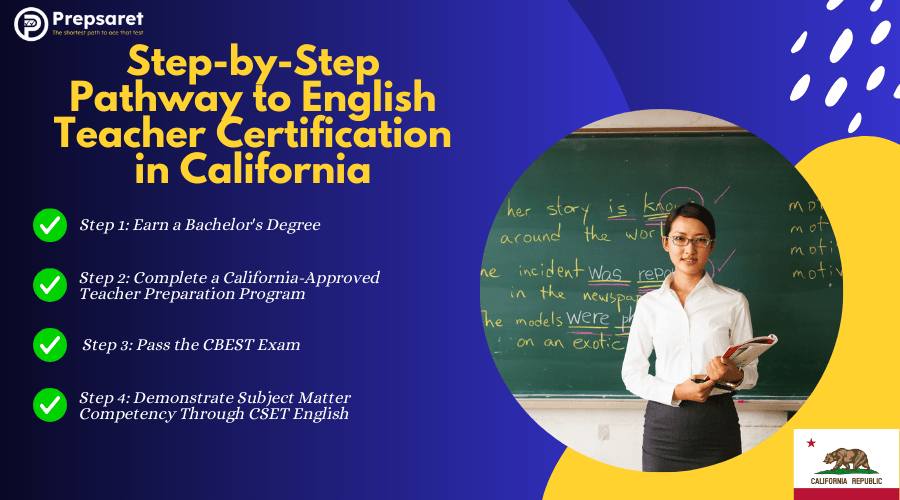
Step 1: Earn a Bachelor’s Degree
Your journey begins with obtaining a bachelor’s degree from an accredited institution. While your undergraduate major doesn’t necessarily have to be English or English Education, having strong coursework in English Literature, Composition, Linguistics, or related fields will significantly benefit your preparation for the subject matter exams you’ll face later.
Many aspiring English teachers choose to major in English, Comparative Literature, Creative Writing, or Journalism. Others pursue Liberal Studies or Humanities with a concentration in English. If you’re already working on or have completed a degree in an unrelated field, you can still become an English teacher—you’ll simply need to demonstrate subject matter competency through examination.
During your undergraduate years, maintaining a solid GPA is important, particularly if you plan to apply to competitive credential programs. Most programs require a minimum GPA of 2.67-2.75, though more selective programs may expect higher academic performance.
Step 2: Complete a California-Approved Teacher Preparation Program
The cornerstone of California teacher certification is completion of an accredited teacher preparation program. These programs are offered through universities, colleges, and alternative certification organizations throughout the state, all approved by the California Commission on Teacher Credentialing.
Traditional University Programs: These are typically one to two-year programs offered at the post-baccalaureate level. You’ll take coursework in educational theory, child and adolescent development, classroom management, assessment strategies, and methods specific to teaching English Language Arts. Programs include supervised student teaching placements where you’ll gain hands-on experience in actual classrooms.
Alternative Certification Routes: California also offers alternative pathways for career-changers and those who need more flexible scheduling. Programs like intern credentials allow you to teach in a classroom while completing your credential requirements, though you’ll work under supervision and must meet specific program requirements.
Your preparation program should specifically prepare you for teaching English as a Single Subject area. This means extensive coursework in:
- Methods of teaching literature analysis and interpretation
- Writing instruction across genres (narrative, expository, persuasive, research-based)
- Grammar and language conventions instruction
- Reading comprehension strategies for diverse learners
- Integrating technology and media literacy in English instruction
- Differentiation strategies for English Language Learners and students with diverse needs
- Assessment and evaluation of student writing and reading comprehension
- Classroom management specific to discussion-based and workshop-style English classes
Read on: Praxis Requirements in California
Step 3: Pass the CBEST Exam
The California Basic Educational Skills Test (CBEST) is a basic skills competency exam required for all teaching candidates in California. You can take the CBEST before, during, or after your preparation program, though many candidates complete it early in their credentialing journey.
The CBEST assesses foundational skills in three areas:
Reading Section: This portion contains approximately 50 multiple-choice questions that evaluate your ability to comprehend and analyze written passages. You’ll encounter passages from various sources—literary texts, historical documents, scientific articles, and practical reading materials. Questions assess critical analysis, drawing inferences, determining main ideas, recognizing author’s purpose and tone, and evaluating supporting evidence.
Mathematics Section: Approximately 50 multiple-choice questions test numerical and statistical reasoning, algebra and functions, measurement and geometry. While this is a basic skills test, it does require understanding of mathematical concepts you’ll need to interpret data, understand educational statistics, and support students across content areas.
Writing Section: You’ll compose two essays within the time limit. Topics typically ask you to analyze a situation and take a position, or to write about a personal experience relevant to education. Essays are evaluated on clarity of expression, organization, development of ideas, grammar, and mechanics.
CBEST Format and Scoring: The exam can be taken as a full battery (all three sections in one sitting) or section by section. The computer-based test is offered year-round at testing centers throughout California. Each section is scored on a scale of 20-80, and you need a total scaled score of 123 across all three sections, with no single section scoring below 37. This means you can compensate for a weaker area with stronger performance in another section.
Preparation Tips: Most test-takers find the CBEST manageable with focused preparation. Review basic mathematical concepts if it’s been years since you’ve worked with fractions, percentages, or geometry. For the writing section, practice timed essay writing, focusing on clear thesis statements and well-organized paragraphs. The reading section is often the strongest area for aspiring English teachers, but don’t become overconfident—practice active reading strategies and time management.
Step 4: Demonstrate Subject Matter Competency Through CSET English
The California Subject Examinations for Teachers (CSET): English is where you’ll prove your mastery of the content you’ll be teaching. This comprehensive examination ensures you have the deep subject matter knowledge required to teach English Language Arts effectively at the secondary level.
The CSET English consists of four subtests, and you must pass all four to demonstrate subject matter competency:
Subtest I: Reading Literature and Informational Texts (Multiple Choice)
This subtest contains approximately 30 multiple-choice questions covering:
- Literary genres, devices, and elements (fiction, drama, poetry, non-fiction)
- Literary periods and movements in British, American, and World literature
- Analysis of themes, characterization, plot structure, setting, and point of view
- Rhetorical devices and figurative language
- Critical approaches to literature (historical, biographical, feminist, post-colonial, etc.)
- Informational text structures and comprehension strategies
- Media literacy and analysis of visual and multimedia texts
You’ll need comprehensive knowledge spanning from classical literature (Greek drama, Shakespeare) through contemporary works, including diverse voices and multicultural literature. Expect questions about major authors, literary movements (Romanticism, Realism, Modernism, etc.), and the ability to analyze excerpts you may not have previously read.
Subtest II: Language, Linguistics, and Literacy (Multiple Choice)
Approximately 30 multiple-choice questions assess your understanding of:
- English language structure (phonology, morphology, syntax, semantics)
- Grammar and language conventions (parts of speech, sentence structure, punctuation)
- Language acquisition and development theories
- History and evolution of the English language
- Dialect variation and Standard English
- Second language acquisition principles relevant to English Language Learners
- Reading development and literacy instruction
- Vocabulary development strategies
- Research-based reading instruction approaches
This subtest requires technical knowledge of linguistics that goes beyond simply being able to write correctly. You should understand grammatical terminology, sentence diagramming, language history (Old English through Modern English), and theories of how students acquire language and literacy skills.
Subtest III: Composition and Rhetoric (Multiple Choice + Written Response)
This section combines approximately 20 multiple-choice questions with two constructed-response assignments:
Multiple-choice questions cover:
- Writing process stages (prewriting, drafting, revising, editing, publishing)
- Rhetorical strategies and modes (narrative, expository, persuasive, descriptive)
- Audience awareness and purpose in writing
- Organization and development of ideas
- Research skills and integration of sources
- Citation practices and avoiding plagiarism
- Peer review and collaborative writing strategies
The two constructed-response questions typically require you to:
- Analyze a writing sample, identifying strengths and weaknesses, and provide specific instructional feedback
- Develop a detailed instructional plan for teaching a specific writing skill or process, demonstrating knowledge of effective pedagogy
Subtest IV: Communications: Speech, Media, and Creative Performance (Written Response)
This subtest consists of three constructed-response assignments focusing on:
- Oral communication instruction (listening, speaking, presentation skills)
- Analyzing and teaching speeches or oral texts
- Media literacy and analysis (film, advertising, news media, digital media)
- Performance aspects of literature (dramatic interpretation, reader’s theater)
- Collaborative discussion and Socratic seminar techniques
- Instructional strategies for developing students’ communication skills
Your responses need to demonstrate not just content knowledge but pedagogical understanding—how you would teach these skills to secondary students.
CSET English Scoring and Passing Requirements
Each subtest is scored separately on a scale of 100-300, with 220 being the passing score for each. You must pass all four subtests, but you don’t have to take them all at once. Many candidates strategically space out their subtests, focusing intensive study on one or two at a time.
The multiple-choice questions are machine-scored, while constructed responses are evaluated by trained scorers using detailed rubrics. Written responses are assessed on:
- Depth and accuracy of content knowledge
- Application of subject-specific pedagogy
- Organization and clarity of expression
- Use of relevant examples and details
- Completeness of response to all parts of the prompt
Strategic Preparation for CSET English
The CSET English is rigorous and requires substantial preparation, particularly if your undergraduate degree wasn’t specifically in English or if it’s been years since you studied literature comprehensively. Here’s how to approach your preparation:
For Subtest I: Create a systematic survey of major literary works, authors, and periods. You can’t possibly read everything, but you should have familiarity with representative works from each major period and genre. Use comprehensive literature handbooks and study guides that provide overviews of major works, themes, and historical context. Practice analyzing unfamiliar passages—the exam will likely include excerpts you haven’t read before, so develop strong cold-reading analytical skills.
For Subtest II: This subtest requires the most technical study for many candidates. Review English grammar systematically, including parts of speech, clause types, sentence patterns, and punctuation rules. Study linguistics concepts including phonemes, morphemes, syntax trees, and language acquisition theories. Many candidates find this the most challenging subtest because it requires explicit knowledge of concepts they may use intuitively but haven’t studied formally.
For Subtest III: Practice timed essay writing focused on pedagogical applications. Review major composition theorists and research-based writing instruction practices. Familiarize yourself with various writing instruction models (6+1 Traits, Writer’s Workshop, process writing approach). When practicing constructed responses, always include specific, detailed instructional strategies rather than vague generalizations.
For Subtest IV: This is often considered the most straightforward subtest for English teachers. Review basic communication theories, speech analysis techniques, and media literacy concepts. Focus on connecting content to practical instructional strategies for the classroom.
Timeline Recommendation: Allow 3-6 months of dedicated preparation time if you’re studying independently. If you’re enrolled in a credential program, your coursework will cover much of this content, making preparation more efficient.
Step 5: Complete Student Teaching Requirements
Your teacher preparation program will include a student teaching or clinical practice component, typically during your final semester or year. This supervised teaching experience is where theory meets practice, and you’ll develop the classroom management, lesson planning, and instructional skills essential for effective teaching.
Structure of Student Teaching: Most programs require a full semester of student teaching, during which you’ll gradually assume increasing responsibility for planning and delivering instruction. You’ll typically begin by observing your master teacher, then co-teach lessons, and eventually take over full instructional responsibility for several weeks.
Your student teaching placement should ideally be in a secondary English classroom (grades 7-12) where you’ll teach multiple class periods and experience the full scope of an English teacher’s responsibilities. This includes:
- Planning and delivering literature-based lessons
- Teaching writing across genres and guiding students through the writing process
- Facilitating class discussions and Socratic seminars
- Assessing student work and providing meaningful feedback
- Differentiating instruction for diverse learners
- Managing classroom behavior and creating a positive learning environment
- Communicating with parents and participating in school community
Supervision and Evaluation: Throughout your student teaching, you’ll receive regular observations and feedback from both your university supervisor and your cooperating teacher (the classroom teacher who hosts you). These evaluations assess your developing competencies across multiple domains, including lesson planning, instructional delivery, assessment practices, classroom management, and professional dispositions.
Making the Most of Student Teaching: Approach this experience with enthusiasm and humility. Ask questions, try new instructional strategies, reflect on both successes and challenges, and build relationships with students. Many student teachers receive job offers from schools where they complete their placements, so treat this as both a learning experience and an extended job interview.
Step 6: Apply for Your Preliminary Teaching Credential
Once you’ve completed your preparation program, passed all required exams, and received your program’s recommendation, you’re ready to apply for your Preliminary Single Subject Teaching Credential in English through the California Commission on Teacher Credentialing.
Your credential program will typically guide you through this application process. You’ll need to submit:
- Official transcripts demonstrating your bachelor’s degree completion
- Verification of program completion from your credential program
- Proof of passing scores on CBEST and all CSET English subtests
- Certificate of Clearance (background check and fingerprinting)
- Application fees (approximately $100)
The CTC will review your application and, if all requirements are met, issue your Preliminary Credential. This credential is valid for five years and authorizes you to teach English in California public schools.
Important Note: Your Preliminary Credential is not your final credential. It’s the first stage of a two-tier system, and you’ll need to complete additional requirements during your first years of teaching to advance to a Clear Credential.
Step 7: Complete a Two-Year Induction Program
The Preliminary Credential comes with a critical requirement: you must complete an approved induction program during your first two years of teaching. Think of induction as your “residency” period—you’re a fully credentialed teacher with your own classroom, but you’re still receiving structured support, mentoring, and professional development.
What Induction Involves: Induction programs are offered by school districts, county offices of education, and university-based consortia. When you’re hired for your first teaching position, your employer will typically enroll you in their affiliated induction program.
Throughout your two years of induction, you’ll:
- Work with an assigned mentor teacher who provides regular coaching and support
- Engage in collaborative inquiry into your teaching practice
- Set individualized learning goals based on the California Standards for the Teaching Profession
- Collect evidence of your developing competencies through a portfolio
- Participate in professional learning communities with other beginning teachers
- Receive ongoing feedback and formative assessment of your teaching
Induction is designed to ease the transition from student teacher to independent professional, reducing the isolation many new teachers feel and providing targeted support during the challenging early years of your career.
Step 8: Obtain Your Clear Credential
Upon successful completion of your induction program, you’ll apply for your Clear Single Subject Teaching Credential in English. The Clear Credential has no expiration date but must be renewed every five years through completion of ongoing professional development requirements.
With your Clear Credential, you’ve achieved full professional status as a California English teacher. You’ll continue to engage in professional growth throughout your career, but you’ve met all the initial certification requirements.
Alternative and Accelerated Pathways
California recognizes that high-quality teachers come from diverse backgrounds, and several alternative pathways exist for career-changers, returning professionals, and those with relevant experience but non-traditional preparation.
Intern Credentials
If you hold a bachelor’s degree and have passed CBEST and CSET English, you may qualify for an Intern Credential, which allows you to teach as the teacher of record while completing your credential program requirements. This pathway is particularly common in high-need areas and allows you to earn a salary while completing your preparation.
Intern programs are rigorous—you’re learning on the job while taking coursework in evenings, weekends, or summers. You’ll receive intensive support and supervision, but it’s demanding to simultaneously manage a full teaching load and credential coursework. However, for many career-changers, especially those with financial obligations, this pathway makes credentialing financially feasible.
District Intern Programs
Some large school districts operate their own intern programs in partnership with universities or as independent programs. These district-intern pathways recruit candidates, employ them as teachers, and provide integrated preparation, often with financial support such as tuition assistance or stipends.
Teacher Residency Programs
Modeled after medical residencies, teacher residency programs offer intensive, year-long training where you work alongside an experienced mentor teacher while taking coursework. These programs often include financial support and typically lead to a commitment to teach in the partner district for several years after completion.
Understanding California’s Teaching Credential Types and Authorizations
Your Single Subject Teaching Credential in English authorizes you to teach English Language Arts courses at the secondary level. However, California’s credentialing system includes various supplementary authorizations you might pursue:
English Learner Authorization: California requires all teachers to have preparation in effective instruction for English Language Learners. This is typically embedded in your credential program, but if you completed an out-of-state program, you may need to add this authorization separately.
Special Education Authorization: Some teachers pursue supplementary authorization in special education, allowing them to serve students with mild to moderate disabilities. This requires additional coursework and assessment.
Cross-Cultural Language and Academic Development (CLAD) Certificate: For teachers who want additional specialization in teaching English learners, this certificate (or its newer equivalents) provides advanced preparation.
Related blog post: Praxis Test California
Career Prospects and Job Market for English Teachers in California
California faces ongoing teacher shortages in many regions, particularly in urban and rural areas. English teaching positions are generally more competitive than some other subject areas (like math or special education), but qualified candidates with strong credentials and flexibility about location typically find employment successfully.
Where English Teachers Are Needed: Urban districts in Los Angeles, San Diego, Sacramento, and the Bay Area consistently hire English teachers. Rural and inland regions (Central Valley, Imperial County, northern California) often have more immediate openings and less competition. Charter schools also employ significant numbers of credentialed English teachers.
Salary Expectations: Starting salaries for California teachers vary significantly by district, ranging from approximately $45,000 to $65,000 for first-year teachers, with higher salaries in coastal urban districts and lower salaries in rural areas. California teachers’ salaries are structured on experience and education ladders, with significant increases for years of service and advanced degrees. The state average teacher salary is among the highest in the nation, though cost of living varies dramatically across California regions.
Career Advancement: English teachers can advance into leadership roles such as department chair, literacy coach, curriculum specialist, assistant principal, or principal. Some pursue National Board Certification for professional recognition and salary increases. Others specialize in Advanced Placement, International Baccalaureate, or dual enrollment instruction.
Common Challenges and How to Overcome Them
Becoming an English teacher in California is a significant undertaking, and understanding common challenges helps you prepare for success:
Challenge 1: CSET English Difficulty
Many candidates underestimate the breadth and depth of the CSET English exams. The content spans centuries of literature, technical linguistics, composition theory, and pedagogy.
Solution: Begin preparing early, ideally 4-6 months before your first subtest. Use official preparation materials from the CTC website, including test frameworks and sample questions. Consider study groups with other credential candidates. Focus your preparation on areas outside your undergraduate focus—if you studied primarily American literature, devote extra time to British and World literature. If you haven’t studied linguistics formally, allocate significant time to Subtest II content.
Challenge 2: Balancing Credential Program Demands
Credential programs are intensive, with rigorous coursework, extensive reading, lesson planning, and teaching requirements all occurring simultaneously.
Solution: Treat your credential program as a full-time commitment even if you’re also working. Develop strong organizational systems for tracking assignments, observations, and requirements. Build relationships with cohort members for mutual support and collaboration. Communicate proactively with your instructors if you’re struggling with workload or understanding.
Challenge 3: Student Teaching Stress
The transition from observer to responsible teacher can be overwhelming. Managing multiple classes, establishing authority, delivering effective instruction, and handling unexpected situations requires skills that develop over time.
Solution: Maintain open communication with your cooperating teacher and university supervisor. Don’t hesitate to ask for help or advice. Reflect regularly on your practice, identifying both successes and areas for growth. Remember that all teachers struggled during their early teaching experiences—this is a normal part of professional development, not a sign that you’re not meant to teach.
Challenge 4: Financial Strain During Preparation
Many credential candidates face financial pressure, especially during student teaching when full-time employment is difficult or impossible.
Solution: Research financial aid options specifically for teacher candidates, including grants, scholarships, and loan forgiveness programs. Some credential programs offer stipends or paid student teaching placements. Consider intern credential pathways if you need to earn a salary while completing requirements. Plan ahead financially and reduce expenses during your credential year if possible.
Challenge 5: Job Search After Credentialing
The teacher job market varies by region and timing, and some newly credentialed teachers face a competitive or uncertain job search.
Solution: Begin your job search early—many districts hire in spring for positions beginning in fall. Apply broadly, including districts you might not have initially considered. Prepare a strong application portfolio including a compelling cover letter, polished resume, teaching philosophy statement, and evidence of teaching effectiveness (lesson plans, student work samples, observation feedback). Practice interview skills, particularly teaching demonstrations. Network through your credential program, student teaching placement, and professional organizations. Consider substitute teaching to build connections and experience while searching for a permanent position.
Timeline for Becoming an English Teacher in California
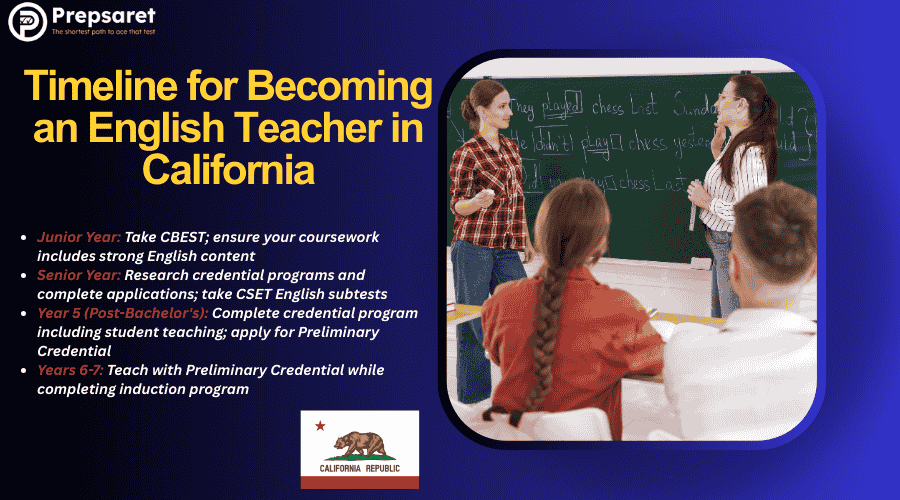
If You’re Currently in College (Pursuing a Bachelor’s Degree):
- Junior Year: Take CBEST; ensure your coursework includes strong English content
- Senior Year: Research credential programs and complete applications; take CSET English subtests
- Year 5 (Post-Bachelor’s): Complete credential program including student teaching; apply for Preliminary Credential
- Years 6-7: Teach with Preliminary Credential while completing induction program
- Year 8+: Teach with Clear Credential
If You Already Hold a Bachelor’s Degree:
- Months 1-2: Research credential programs and complete applications; register for CBEST
- Months 3-6: Prepare for and take CSET English subtests; complete any prerequisite requirements
- Months 6-18: Complete credential program including student teaching
- Year 2: Apply for Preliminary Credential and begin teaching position
- Years 2-4: Complete induction program while teaching
- Year 5+: Teach with Clear Credential
Accelerated Timeline (Intern Pathway):
- Months 1-3: Pass CBEST and all CSET English subtests
- Months 4-6: Complete program prerequisites and secure intern teaching position
- Years 1-2: Teach with Intern Credential while completing credential coursework
- Years 2-4: Complete induction program with Preliminary Credential
- Year 5+: Teach with Clear Credential
Essential Resources for Your Credentialing Journey
California Commission on Teacher Credentialing (CTC): The CTC website (ctc.ca.gov) is your authoritative source for all credential requirements, applications, and updates to credentialing policies. Create an account to track your progress and manage your credential applications.
CBEST Information and Registration: Register for the CBEST and access preparation materials through the official testing website. The CBEST can be taken year-round at computer-based testing centers.
CSET Information and Study Materials: The CSET website provides detailed test frameworks for all subtests, which outline exactly what content is covered. These frameworks should guide your preparation. Sample questions and constructed response examples are also available.
Credential Program Research: Use the CTC’s program directory to find accredited credential programs. Contact programs directly to learn about their specific requirements, cohort schedules, costs, and placement support.
Professional Organizations: Join the California Teachers Association (CTA), the National Council of Teachers of English (NCTE), and the California Association of Teachers of English (CATE) for professional development, networking, and resources specific to English teaching.
For comprehensive preparation support, visit prepsaret.com for practice tests and study materials.
Continue reading: Best Praxis study resources
Frequently Asked Questions
How long does it take to get an English teaching credential in California?
The entire process typically takes 1 to 2 years, depending on your pace in completing exams and student teaching requirements.
What exams do I need to take for English teacher certification in California?
You need to pass the CBEST exam and the CSET English exam as part of the certification process.
What is the role of student teaching in the certification process?
Student teaching provides practical experience in a classroom setting, allowing you to apply your knowledge and skills under the supervision of a licensed teacher.
Can I teach English without a credential in California?
Generally, you need a teaching credential to teach in California public schools. However, there may be alternative pathways for private schools.
What resources are available for studying for the CSET English exam?
Many resources are available, including official study guides, online practice tests, and preparation courses offered by universities and educational organizations.
Conclusion
Becoming an English teacher in California is a meaningful and achievable goal. By understanding the certification pathway, preparing strategically for required exams, and staying focused on each step, you can move forward with confidence. With the right preparation and mindset, passing your exams on the first attempt—and earning your English teaching credential in California—is well within reach.