

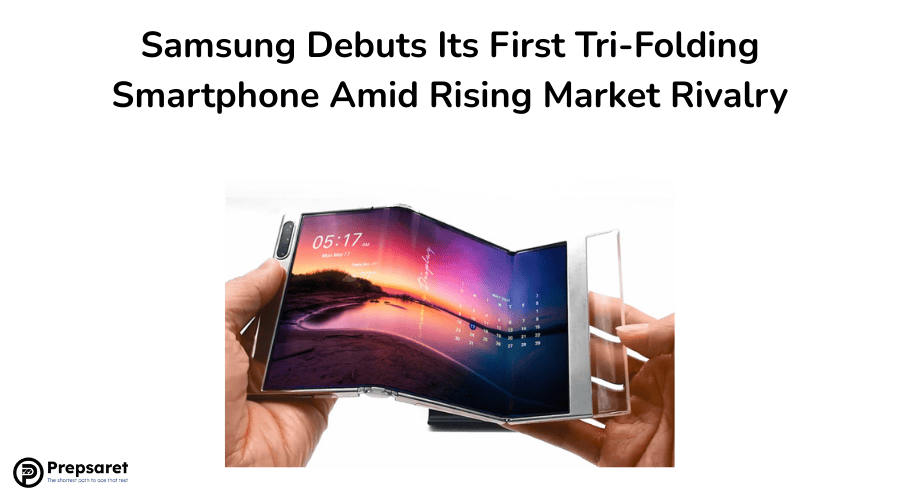
Samsung Electronics introduced its first multi-fold smartphone on Tuesday, aiming to solidify its presence in a part of the mobile market where competition is expected to ramp up.
The debut of the Galaxy Z TriFold signals Samsung’s attempt to defend its lead as Chinese manufacturers continue to advance in foldable technology.
However, experts note that the device’s steep cost and manufacturing complexities suggest the category will continue to cater to a smaller group of consumers for the time being.
The Galaxy Z TriFold, which retails for roughly 3.59 million won ($2,440.17), expands into a 253.1-millimetre (10-inch) screen through its three-panel structure—nearly a quarter larger than Samsung’s recent Galaxy Z Fold 7.
“I believe the foldable market will continue to grow, and the TriFold in particular could act as a catalyst that drives more explosive growth in key parts of the segment,” said Alex Lim, Samsung Electronics Executive Vice President and head of the Korea Sales & Marketing Office.
Lim emphasised that the device targets consumers who specifically want a multi-fold option rather than those seeking a mainstream flagship.
In other stories: Samsung Raises Memory Chip Prices Up to 60% as Supply Tightens
Global Rollout and Key Features
The new model, manufactured in South Korea, will be released domestically on December 12. It is set to reach China, Singapore, Taiwan and the United Arab Emirates before the end of the year, with a U.S. release anticipated as early as the first quarter of next year.
Samsung equipped the TriFold with its most powerful battery in a premium device to date, along with ultra-fast charging that brings the phone to 50% capacity in half an hour. According to Lim, rising expenses for memory chips and other components made pricing a “difficult decision.”
Intensifying Global Competition
Industry observers say the TriFold is more likely to highlight Samsung’s engineering capability than to drive mass sales.
Ryu Young-ho, senior analyst at NH Investment & Securities, noted that “the trifold is a first-generation product, and it’s the first time a trifold design is being commercialised, so it’s hard to see Samsung pushing large volumes at this stage.”
He added that although the Galaxy Z Fold series has benefited from years of refinement and lowered production costs, “the trifold could still face issues around completeness or durability,” making it crucial to monitor consumer feedback.
Rivalry in the foldable arena is expected to escalate as Huawei has already introduced a three-way folding handset, and Apple is anticipated to unveil its first foldable device next year.
Still, analysts say high prices and limited mass-manufacturing capacity will continue to constrain adoption. Counterpoint Research estimates foldables will represent under 2% of smartphone shipments this year, rising to below 3% by 2027.
Samsung’s share of this market surged to 64% in the third quarter—up from 9% previously—highlighting how launch cycles can dramatically shift momentum.
Counterpoint expects the foldable category to expand 14% this year and grow at an annual pace in the 30% range in 2026 and 2027 as Apple enters the field.
Read next: Tech Giants Amazon and Google Introduce High-Speed Multicloud Connectivity Service