

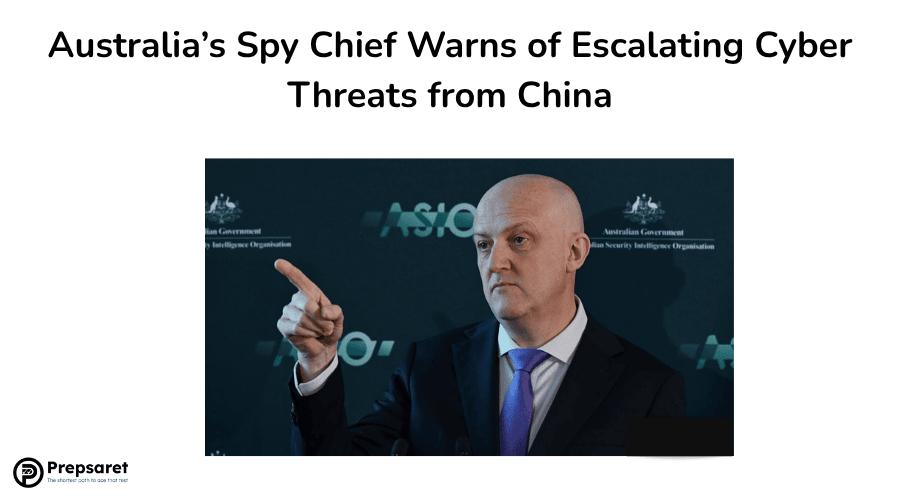
Australia’s top intelligence official has issued a stark warning that hackers associated with China’s government and military are increasingly targeting the nation’s essential infrastructure.
He cautioned that the country faces a growing risk of “high-impact sabotage” that could have devastating consequences.
Mike Burgess, Director-General of the Australian Security Intelligence Organisation (Asio), said the agency is observing “unprecedented levels of espionage,” adding that the likelihood of “cyber-enabled sabotage” is expected to increase significantly over the next five years.
He referred to “one nation state – no prizes for guessing which one – conducting multiple attempts to scan and penetrate critical infrastructure in Australia” and among its allies, including systems managing water, transport, energy, and telecommunications.
The Chinese embassy has been contacted for comment. Burgess warned that authoritarian governments were now more inclined to “disrupt and destroy.”
Related story: Hackers Linked to Nation-State Breach U.S. Telecom Firm Ribbon Communications
Chinese Hacker Groups Linked to Espionage and Disruption
Burgess identified two Chinese hacking groups, Salt Typhoon and Volt Typhoon, that have targeted telecommunications companies in both the United States and Australia.
“These groups are hackers working for Chinese government intelligence and their military,” he told business leaders during a forum in Melbourne on Wednesday.
He explained that Salt Typhoon’s main objective is espionage, breaking into telecommunication networks in the U.S., and added that “they have been probing our telecommunication networks here in Australia too.”
Meanwhile, Volt Typhoon’s operations appear more destructive in nature, compromising U.S. critical infrastructure for possible future acts of sabotage.
“And yes, we have seen Chinese hackers probing our critical infrastructure as well,” Burgess said.
He warned that such attacks are designed to “impede decision-making, damage the economy, undermine war-fighting capability and sow social discord.”
“I do not think we – and I mean all of us – truly appreciate how disruptive, how devastating, this could be,” he added.
Expanding Targets and Economic Impact
Burgess highlighted that even minor outages in communication networks have shown how easily essential services can be disrupted.
“That’s one phone network not working for less than one day,” he noted, asking people to consider the consequences if “a nation-state took down all the networks” or “turned off the power during a heatwave.”
He said foreign intelligence services are increasingly expanding their targets to include private-sector projects, business negotiations, and customer data.
Espionage, he reported, cost Australia about A$12.5 billion ($8.2bn) in 2023–24, including around $2 billion in stolen trade secrets and intellectual property.
Burgess described the hackers’ operations as “highly sophisticated, using top-notch tradecraft” to infiltrate networks, locate weaknesses, and maintain undetected access that could be used for sabotage “at a time and moment of their choosing.”
Read next: The Washington Post Confirms It Was Hit in Oracle-Linked Cyberattack