

Are you preparing to earn your high school equivalency credential? Understanding what subjects are on the HiSET test is your first step toward success. This comprehensive guide breaks down every subject area, question format, and testing requirement you need to know.
At Prepsaret, we provide authentic practice materials that closely mirror the actual exam, helping thousands of test-takers achieve their goals with confidence.
HiSET Exam Format and Structure
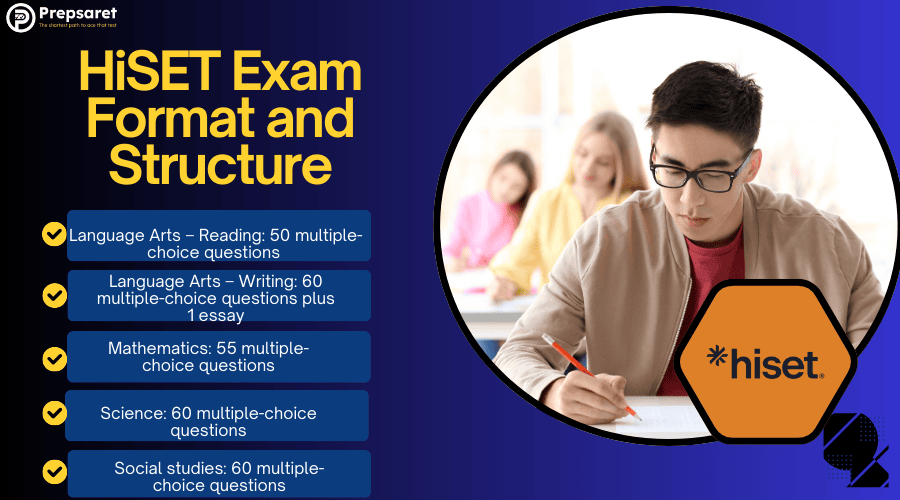
The HiSET exam structure is designed to assess your knowledge across five distinct subject areas. Unlike a traditional high school final exam, this high school equivalency exam evaluates your cumulative learning in a standardized format that’s accepted nationwide.
Here’s how the HiSET test sections are organized:
- Math: 55 multiple-choice questions (90 minutes)
- Reading: 50 multiple-choice questions (65 minutes)
- Writing: 60 multiple-choice questions + 1 essay (120 minutes total)
- Science: 60 multiple-choice questions (80 minutes)
- Social Studies: 60 multiple-choice questions (70 minutes)
The HiSET exam format allows you to take all five subtests in one day or spread them out over multiple sessions, depending on your state’s policies. Each section is scored separately on a scale of 1-20, and you’ll need a minimum score of 8 on each subtest and a total combined score of 45 to pass.
Understanding the HiSET test categories helps you allocate your study time effectively. The exam uses both computer-based and paper-based formats, though many testing centers now primarily offer digital versions.
The HiSET core subjects remain consistent regardless of format, ensuring standardized assessment across all testing locations.
What Subjects Do You Need to Pass the HiSET Test?
You must demonstrate proficiency in all five HiSET exam topics: Mathematics, Reading, Writing, Science, and Social Studies. There’s no way to skip a section—each represents essential knowledge for high school equivalency.
Wondering how many subjects are on the HiSET exam? Exactly five subjects comprise the complete assessment.
What Does the HiSET Test Cover in Each Section?
Understanding the HiSET subject areas is only the first step. To succeed, it’s essential to follow a structured approach for how to prepare for the five HiSET test subjects, including dedicated study sessions for each core area and using practice materials that reflect real exam questions.
Let’s break down what’s on the HiSET exam:
- Mathematics tests your ability to solve problems involving numbers, algebra, geometry, and data analysis. You’ll encounter questions requiring both calculation and conceptual understanding.
- Reading measures your comprehension skills using passages from literature, informational texts, and workplace documents. You’ll analyze themes, identify main ideas, and draw inferences.
- Writing evaluates your grammar knowledge through multiple-choice questions and your composition skills through a timed essay. You’ll demonstrate your ability to organize ideas, support arguments, and use proper conventions.
- Science covers physical science, life science, and Earth/space science. Questions require you to interpret data, understand scientific concepts, and apply the scientific method.
- Social Studies encompasses history, geography, civics, government, and economics. You’ll need to analyze historical documents, understand governmental structures, and interpret social science data.
The HiSET subject areas are intentionally broad to ensure you possess well-rounded knowledge equivalent to a high school graduate. Each section contributes equally to your overall credential, making it essential to prepare thoroughly for all five areas.
HiSET Math Content Outline
The Math section can feel overwhelming for many test-takers, so understanding what subjects are on the HiSET test Math is essential for effective preparation. The official HiSET test breakdown shows that the exam focuses on four major domains measuring your quantitative reasoning and problem-solving skills.
Numbers and Operations on Numbers (19-22%)
- Rational numbers and their operations
- Ratios, proportions, and percentages
- Number properties and absolute value
- Scientific notation and exponents
Measurement and Geometry (17-20%)
- Perimeter, area, and volume calculations
- Coordinate plane and graphing
- Geometric properties and transformations
- Pythagorean theorem applications
Data Analysis, Probability, and Statistics (17-20%)
- Statistical measures (mean, median, mode)
- Data interpretation from graphs and charts
- Probability calculations
- Data collection and representation
Algebraic Concepts (31-34%)
- Linear equations and inequalities
- Polynomials and factoring
- Functions and their graphs
- Systems of equations
Wondering what topics are included in HiSET Math? These four domains make up the full structure of the exam. Math is often considered one of the easiest and hardest subjects on the HiSET test depending on your background—some students excel with numbers, while others struggle with multi-step reasoning.
Although you’ll receive a formula sheet and can use a calculator on all questions, true success comes from understanding how to apply mathematical concepts, not just memorizing steps.
Try this out: Free HiSET Math Practice Questions
HiSET Reading – What to Expect on the Test
HiSET Reading evaluates your ability to analyze and understand a wide range of texts. Knowing what to expect on the HiSET Reading and Writing test starts with understanding how the reading section is organized and the skills it measures.
The reading passages fall into three categories:
Literary Texts (40%)
- Fiction excerpts from novels and short stories
- Poetry selections
- Drama passages
- Character analysis and theme identification
Informational Texts (30%)
- Nonfiction articles and essays
- Historical documents
- Scientific reports
- Biographical accounts
Workplace and Community Documents (30%)
- Business communications
- Technical instructions
- Consumer materials
- Policy documents
Across all passages, questions assess your ability to:
- Identify main ideas and supporting details
- Make inferences and draw conclusions
- Analyze author’s purpose and perspective
- Understand vocabulary in context
- Recognize organizational structures
- Compare and contrast information
Because HiSET subject areas involving reading require active engagement, you’ll need to read critically—highlighting key details, revisiting paragraphs, and analyzing text structures. With 50 questions to complete, aim for about 90 seconds per item to manage your 65-minute time limit effectively.
Read More: Free HiSET Reading Practice test
What to Study for the HiSET Writing Section
HiSET writing consists of two parts that assess your written communication skills. Understanding the breakdown of each HiSET subject and question format helps you prepare effectively for this 120-minute section.
Part 1: Multiple-Choice Questions (50 questions, 75 minutes)
These questions test:
- Grammar and usage rules
- Sentence structure and clarity
- Punctuation and capitalization
- Organization and paragraph structure
- Word choice and tone
You’ll read passages with underlined portions or numbered sentences and identify errors or select the best revision. Some questions ask you to improve transitions or reorganize ideas for better flow.
Part 2: Essay (1 prompt, 45 minutes)
The essay requires you to:
- Take a clear position on an issue
- Develop arguments with specific examples
- Organize ideas logically
- Use proper conventions and vocabulary
- Write 300–500 words demonstrating college-readiness
Preparation Tips:
- Review grammar and usage rules
- Practice timed essays
- Learn to quickly identify errors in context
A study guide for all HiSET subjects should dedicate significant time to writing practice. Prepsaret offers targeted HiSET practice test exercises that closely mirror actual test questions, giving you the practice you need to excel.
Try Out: Free HiSET Writing Practice Questions
HiSET Science Topics You Need to Know
HiSET Science evaluates your understanding of scientific principles and your ability to apply the scientific method. The HiSET Science topics you need to know span three major areas within the HiSET test content:
Physical Science (31-34%)
- Matter and its properties
- Chemical reactions and changes
- Motion, forces, and energy
- Waves, electricity, and magnetism
Life Science (31-34%)
- Cell structure and function
- Heredity and genetics
- Evolution and natural selection
- Ecosystems and environmental science
- Human body systems
Earth and Space Science (31-34%)
- Earth’s structure and processes
- Weather and climate patterns
- Astronomy and the solar system
- Natural resources and their management
The 60 multiple-choice questions assess your ability to:
- Interpret scientific data from charts, graphs, and tables
- Analyze experimental designs
- Draw conclusions from evidence
- Apply scientific concepts to real-world scenarios
- Understand scientific vocabulary in context
You won’t need to have every scientific fact memorized. Instead, focus on understanding core concepts and developing skills to interpret new information presented in questions. The test provides all necessary data within each question, so your task is to analyze and apply that information correctly.
Try Out: Free HiSET Science Practice Questions
HiSET Social Studies Content Outline and Structure
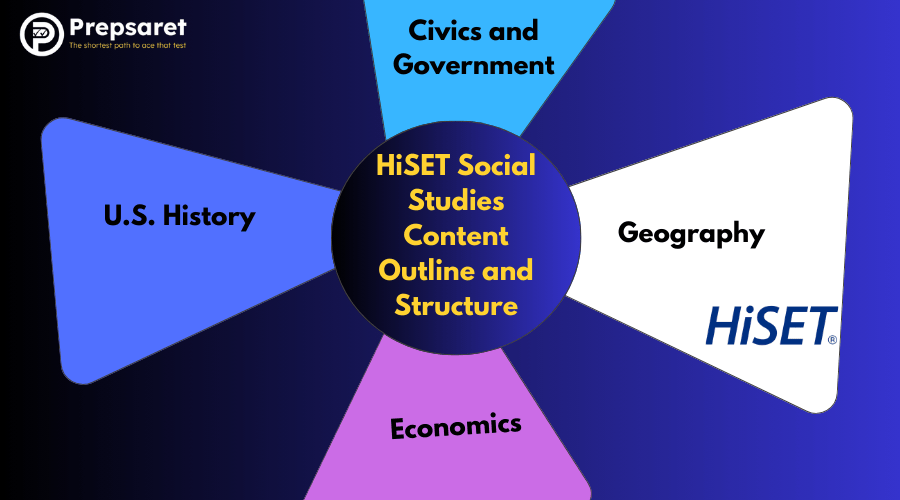
The HiSET Social Studies section measures your understanding of multiple social science disciplines. This HiSET Social Studies content outline covers five major areas that reflect the core concepts commonly taught in high school social studies.
History (30%)
- U.S. History from colonization through present day
- World history and global events
- Historical interpretation and analysis
- Cause-and-effect relationships in history
Civics and Government (25%)
- U.S. government structure and function
- Constitutional principles and rights
- Democratic processes and citizenship
- Political systems and international relations
Economics (20%)
- Economic systems and principles
- Supply and demand
- Personal finance and consumer economics
- Global economic relationships
Geography (15%)
- Physical and human geography
- Map reading and spatial analysis
- Regional characteristics
- Human-environment interaction
World Events and Current Issues (10%)
- Contemporary global challenges
- Cultural diversity and interaction
- Social movements and change
As a High School Equivalency Test, the HiSET Social Studies section focuses on analytical thinking rather than memorization. You’ll interpret primary sources, charts, political cartoons, and maps.
Questions require you to evaluate evidence, compare perspectives, and apply Social Science concepts to real-world scenarios. Understanding what subjects are on the HiSET test means recognizing that Social Studies integrates multiple disciplines into a comprehensive assessment of your civic literacy and historical understanding.
Try Out: HiSET Social Studies Practice Test
What Subjects Are on the HiSET Test in California?
The core subject content remains consistent nationwide—you’ll still be tested on Math, Reading, Writing, Science, and Social Studies regardless of where you take the exam. However, HiSET testing requirements can vary by state in several important ways:
California-Specific Considerations:
- Testing accommodations and accessibility services
- Scheduling procedures and testing center availability
- Score reporting timelines
- Retesting policies and fees
- Age requirements and residency verification
While what subjects are on the HiSET test stays the same across all states, individual states may impose additional requirements such as:
- Minimum age requirements (typically 16-18 years old)
- Parental consent for underage test-takers
- Proof of withdrawal from traditional school
- Residency documentation
- Waiting periods between test attempts
California and other states that offer the HiSET maintain the same scoring standards and passing criteria. Your credential will be equally valid regardless of which state issued it, making this a truly national high school equivalency option.
Check with your state’s Department of Education or testing authority to confirm specific policies, fees, and registration procedures. The content you’ll study remains universal, but administrative details vary.
Check Out: HiSET Eligibility Requirements
Comparing HiSET vs GED Subjects

Many test-takers wonder about HiSET vs GED differences when choosing their high school equivalency path. Understanding HiSET vs GED subjects helps you make an informed decision about which test suits your strengths.
HiSET vs GED Subject Area Comparison
Both tests cover similar high school equivalency exam topics, but there are notable differences:
HiSET Core Subjects:
- Five separate tests (Math, Reading, Writing, Science, Social Studies)
- Writing includes multiple-choice questions plus essay
- Tests can be taken separately over time
- Calculator allowed on entire math section
- 7 hours and 5 minutes total testing time
GED Subjects:
- Four combined tests (Mathematical Reasoning, Reasoning Through Language Arts, Science, Social Studies)
- Writing integrated into Reasoning Through Language Arts
- More compressed testing schedule
- Calculator allowed on some math questions only
- Approximately 7 hours total testing time
When examining what subjects are on the HiSET test versus the GED, you’ll notice the HiSET separates Reading and Writing into distinct assessments, while the GED combines them. The HiSET also tends to have a more straightforward question format with traditional multiple-choice items, whereas the GED includes more technology-enhanced questions like drag-and-drop and fill-in-the-blank.
HiSET vs GED: Which Is Easier?
Neither test is objectively “easier”—it depends on your learning style and strengths. The HiSET may benefit test-takers who:
- Prefer traditional multiple-choice formats
- Want to spread testing over multiple sessions
- Feel more comfortable with extended time per subject
- Appreciate having calculator access throughout math sections
Choose based on your personal preferences, state availability, and which format aligns better with your testing strengths. Both credentials hold equal value for employment and college admission.
Find Out: Is HiSET Harder Than GED?
Free & Paid HiSET Study Resources
Finding reliable materials is essential when learning what subjects are on the HiSET test. High-quality resources help you study each content area effectively and build the skills needed to pass.
Free HiSET Study Resources
You can access what subjects are on the HiSET test PDF study guides and other free materials from trusted public sources, including:
- Official HiSET website (free practice tests and sample questions)
- State education departments (downloadable study materials)
- Public library systems (physical and digital study guides)
- Adult education programs (often provide free classes)
HiSET Online Preparation Tools
The official HiSET online test platform provides computer-based practice that simulates the real testing environment. These HiSET practice test tools help you:
- Familiarize yourself with question formats
- Identify knowledge gaps in specific subjects
- Build testing stamina and time management skills
- Reduce test-day anxiety through exposure
Premium HiSET Test Resources
While free materials provide a foundation, comprehensive HiSET test prep guidance often requires investment in quality resources. Prepsaret stands out as the premier platform for HiSET preparation, offering:
- Actual exam closely mirroring questions that reflect current test content
- Subject-specific practice modules for targeted improvement
- Full-length practice exams with detailed scoring
- Performance analytics identifying your strengths and weaknesses
- Updated content reflecting the latest test specifications
Understanding HiSET passing standards—minimum score of 8 per subtest and a combined score of at least 45—allows you to set realistic goals. With Prepsaret’s accurate and up-to-date practice materials, you’ll know exactly what to expect and how to focus your study efforts.
Investing in quality preparation increases your chances of passing all five subjects on your first attempt. The confidence gained from practicing with authentic questions is invaluable when exam day arrives.
What Subjects Are on the HiSET Test 2026?
The five core subject areas—Math, Reading, Writing, Science, and Social Studies—remain unchanged. However, staying informed about potential updates ensures you’re preparing with current information.
Recent and Upcoming HiSET Test Changes
The HiSET program periodically updates its assessments to align with modern educational standards. Recent adjustments include:
Test Format Evolution:
- Expanded computer-based testing and online proctoring
- Improved accessibility features
- Streamlined registration and score reporting
Scoring Refinements:
- Continued emphasis on college and career readiness
- More detailed diagnostic reports for retesters
Subject Emphasis:
- Updated reading passages reflecting contemporary issues
- Math questions incorporating real-world applications
- Science content addressing current environmental and health topics
- Social studies questions covering recent historical events through early 2025
The core structure of what subjects are on the HiSET test remains stable, and major changes are always announced well in advance.
How to Stay Current
To ensure you’re preparing with the most accurate information:
- Check the official HiSET website for announcements
- Verify testing policies with your state’s education department
- Use recently updated study materials (published within the last 2-3 years)
- Choose prep platforms like Prepsaret that regularly update their content
These updates help ensure your HiSET credential reflects true high school equivalency and prepares you for future educational and career opportunities.
What Subjects Are on the HiSET Test?: FAQs
What Are the 5 Parts of the HiSET Test?
The five parts are Math (55 questions, 90 minutes), Reading (50 questions, 65 minutes), Writing (60 questions, 120 minutes), Science (60 questions, 80 minutes), and Social Studies (60 questions, 70 minutes). Each section is scored separately, and you must pass all five.
What to Expect on the HiSET Test?
Expect multiple-choice questions across all subjects plus one written essay. Questions range from straightforward recall to complex application of concepts. You'll work with charts, graphs, reading passages, and real-world scenarios. The testing environment is quiet and monitored, with specific rules about materials and breaks.
Is HiSET Harder Than GED?
Neither test is objectively harder—they assess similar content differently. The HiSET uses more traditional multiple-choice formats and separates reading from writing, while the GED combines subjects and includes varied question types. Choose based on your strengths: HiSET may suit those who prefer straightforward formats and extended time per subject.
Do Colleges Prefer HiSET or GED?
Colleges view both credentials equally. They're both recognized high school equivalency diplomas accepted by virtually all colleges, universities, employers, and military branches nationwide. Your choice won't affect college admissions—focus on which test better suits your learning style and preparation needs.
What Type of Math Is on HiSET?
HiSET Math covers numbers and operations (19-22%), measurement and geometry (17-20%), data analysis and probability (17-20%), and algebraic concepts (31-34%). You'll solve problems involving fractions, percentages, equations, geometric calculations, and data interpretation. A calculator is allowed throughout the entire math section.
What Subjects Are on the HiSET Test?: Conclusion
Now you understand what subjects are on the HiSET test—five comprehensive areas that demonstrate your high school-level knowledge. Success requires focused preparation across Math, Reading, Writing, Science, and Social Studies.
Don’t leave your future to chance. Prepsaret provides the most accurate practice questions and proven study materials to help you pass confidently. Start preparing today with our authentic exam-closely mirroring resources and join thousands who’ve achieved their high school equivalency goals.