


Maybe you dropped out of high school years ago, or life circumstances prevented you from graduating. Now you’re wondering, can you go to college without a high school diploma or GED? Absolutely.
Multiple pathways exist for motivated learners ready to advance their careers. At Prepsaret, we help students prepare for professional certifications and exams, proving that education is accessible regardless of your background.
Can You Go to College Without a High School Diploma or GED?

Yes. Many institutions now recognize that traditional credentials don’t define a student’s potential. Non-traditional students are a growing part of higher education, and colleges have updated their college entry requirements to accommodate different backgrounds.
While most schools still prefer standard documentation, several legitimate postsecondary education pathways exist for learners without a diploma. You may encounter college readiness assessments that evaluate your academic strengths instead of relying on past records.
For candidates wondering can you go to college without a high school diploma or GED? Yes, your path may look different, but with the right information, preparation, and guidance, higher education is absolutely within reach.
Related post: Can you go to college with a HiSET diploma?
Community College Pathways for Students Without a Diploma
Do you need a high school diploma to go to community college? Not always. Community colleges are among the most accessible options for non-traditional students and have created flexible entry routes for adults without standard credentials.
Community college admission requirements vary widely by state and institution. For candidates wondering can you get into community college without a diploma? It depends on local policies, some schools accept placement tests, while others provide alternative pathways.
What Community Colleges Offer
- Placement testing instead of credential verification
- Adult education programs that let you earn equivalency while taking classes
- Workforce development programs with flexible entry standards
- Bridge programs that transition you into credit-bearing courses
Many colleges recognize that career pathways without a high school diploma exist and design training programs that support students pursuing them.
Ability-to-Benefit (ATB) Program for Students Without a Diploma
The Ability-to-Benefit (ATB) programs represent your best option for accessing federal financial aid. What are Ability-to-Benefit (ATB) requirements for college? Essentially, these programs allow students without high school credentials to demonstrate their preparedness through approved assessments.
Federal financial aid eligibility typically requires a high school diploma or GED, but ATB creates an exception. Through this pathway, you can access Pell Grants and federal student loans, critical resources for funding your education.
How ATB Works
- Take an approved test: Pass one of six approved assessments that measure basic skills
- Complete required credits: Earn at least six credits of college-level coursework
- Demonstrate progress: Show satisfactory academic performance
- Access financial aid: Qualify for federal grants and loans
How to qualify for federal aid without a GED essentially comes down to the ATB pathway. Schools offering ATB programs must be eligible institutions, and not all colleges participate. Research schools in your area that offer this option, it could save you thousands in education costs.
Colleges That Do Not Require High School Diploma or GED

Finding colleges that don’t require high school diploma or GED takes research, but these options do exist, especially for online colleges without a GED requirement designed for working adults.
These institutions understand that motivation and experience matter as much as formal credentials. When searching for colleges that don’t require high school diploma or GED near me, start with community colleges or technical schools, since many use alternative admissions pathways.
If you need more flexibility, colleges that don’t require high school diploma or GED online allow you to learn from anywhere.
Your options include:
- Open-enrollment institutions: Some schools accept students regardless of credentials.
- Competency-based programs: These colleges that accept students without a GED measure what you already know through assessments.
- Age-based admissions: Several colleges that accept students without a diploma or GED in the U.S. enroll adults over a certain age without traditional documents.
- Specialized online programs: Some of the best online colleges that don’t require a high school diploma focus on career-driven training.
Keep in mind that colleges that accept students without a GED may require foundational coursework before you move into your intended major.
Read more: colleges that don’t require high school diploma or GED
What Certifications Can I Get Without a High School Diploma or GED?
Many professional certifications focus on practical skills rather than academic credentials, opening doors to skilled trades and technical careers. The availability varies by location. What certifications can I get without a high school diploma or GED in Texas, for example, includes HVAC technician, commercial driver’s license (CDL), and various construction trade certifications.
What certifications can I get without a high school diploma or GED in Georgia offers similar opportunities in trades and healthcare support roles.
Popular Certificate Programs for Non-Traditional Students
- Healthcare support: Certified Nursing Assistant (CNA), phlebotomy, and medical billing programs often accept students without traditional credentials
- Skilled trades: Electrician, plumber, and HVAC programs through unions and trade schools
- Technology: CompTIA certifications, coding bootcamps, and IT support training
- Transportation: CDL programs and automotive repair certifications
What certifications can I get without a high school diploma or GED in Florida includes many cosmetology programs, construction trades, and hospitality certifications. Vocational program admissions policies vary, but many prioritize aptitude and motivation over academic history.
Understanding pathways to career training without a high school diploma helps you make strategic choices. At Prepsaret, we provide practice tests and study materials for numerous professional certifications, helping you prepare effectively regardless of your educational background.
Alternative Education Options Before Enrolling in College
Sometimes earning credentials first makes sense. High school equivalency options give you the traditional credential colleges recognize, potentially expanding your choices. Three main tests exist: GED, HiSET, and TASC.
The difference between GED, HiSET, and TASC for college admission is minimal, colleges accept all three equally. The GED is most widely recognized, HiSET is accepted in about 20 states, and TASC is available in fewer states. Choose based on availability and which test format suits your learning style.
Preparation Strategies
- Academic bridging programs: These help adult learners refresh skills before testing or enrolling
- College prep for adults: Many community colleges offer free or low-cost preparatory courses
- Online study resources: Platforms like Prepsaret provide targeted practice for equivalency exams and professional certifications
- Adult education centers: Free or subsidized programs in most communities
Academic bridging programs serve as stepping stones, helping you build confidence and skills. They’re particularly valuable if you’ve been out of school for many years.
Related post: How long can you go to college with a HiSET diploma
Steps to Go to College as a Non-Graduate
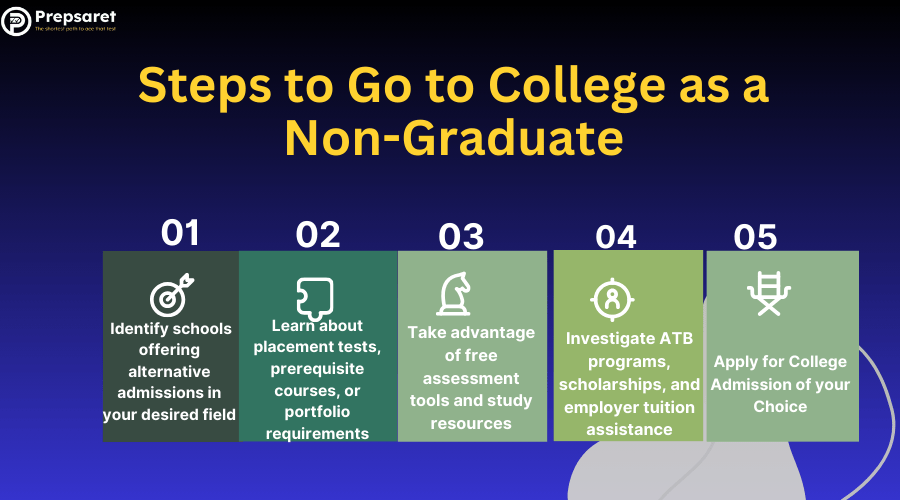
How to go to college without a high school diploma requires strategic planning. Steps to go to college if you never finished high school include:
- Research institutions: Identify schools offering alternative admissions in your desired field
- Understand requirements: Learn about placement tests, prerequisite courses, or portfolio requirements
- Prepare academically: Take advantage of free assessment tools and study resources
- Explore financial aid: Investigate ATB programs, scholarships, and employer tuition assistance
- Start small: Consider taking one or two courses to build confidence and prove capability
- Connect with advisors: Speak with admissions counselors who understand non-traditional students’ needs
How to prepare for college as a non-high school graduate involves honest self-assessment. Test your basic skills in reading, writing, and math. Use resources like Prepsaret to identify knowledge gaps and strengthen weak areas before facing placement tests.
Long-Term Educational and Career Options for Non-Traditional Students
College programs for non-graduates have evolved significantly. Once you gain admission through alternative paths to college admission, your experience largely mirrors traditional students.
You’ll take the same courses, earn the same credentials, and access the same career opportunities. Multiple postsecondary education pathways lead to rewarding careers. Some people earn associate degrees through community colleges, then transfer to four-year institutions.
Others complete certificate programs that lead directly to employment, then pursue degrees while working. Career pathways without a high school diploma exist in growing fields like technology, healthcare, and skilled trades.
Can adults enroll in college without finishing high school? Yes, and many find that their life experience provides valuable context for their studies.
Key Success Factors for Long-Term Educational Goals
- Persistence: Expect challenges but maintain focus on your goals
- Support systems: Connect with other non-traditional students who understand your journey
- Resource utilization: Take advantage of tutoring, counseling, and academic support services
- Strategic planning: Map out a realistic timeline that balances education with work and family obligations
The landscape of postsecondary education pathways continues expanding. Online learning, competency-based education, and micro-credentials create more entry points than ever before.
Can You Go to College Without a High School Diploma or GED: FAQs
What Degree Can You Get Without a High School Diploma or GED?
You can earn certificates, associate degrees, and sometimes bachelor’s degrees. Most students begin with certificate or community college programs. ATB pathways provide access to degree programs at participating institutions.
Is It Possible to Go to University Without a Diploma?
Yes, though it’s more common at community colleges. Some universities accept adults based on age, placement tests, or completed college credits. Policies vary, so research individual institutions.
Can You Be Successful Without a GED or Diploma?
Yes. Many people build strong careers through skills, experience, and training. Still, earning equivalency credentials or certificates expands opportunities and increases long-term earning potential.
Do Colleges Accept Dropouts?
Yes. Colleges often admit high-school dropouts as non-traditional students through alternative pathways. They focus more on readiness, assessments, and motivation than past academic history.
What Grade Is Most Commonly Skipped?
Kindergarten or first grade is skipped most often due to advanced ability. For adults, equivalency exams allow bypassing traditional high-school grades while still pursuing higher education.
Final Thoughts: Can You Go to College Without a High School Diploma or GED
Can you go to college without a high school diploma or GED? Yes. Whether through ATB programs, open-enrollment institutions, or community college pathways, motivated learners have real options.
Success requires research, preparation, and persistence, but the doors are open. At Prepsaret, we support your educational journey with exam prep resources that help you demonstrate competency and advance your career, no matter where you’re starting from.