

Choosing the right CompTIA certification in cybersecurity—Security+, CySA+, or CASP+—can shape your entire career trajectory. Each certification serves a unique level: entry-level cybersecurity certification (Security+), intermediate cybersecurity certification (CySA+), and advanced cybersecurity certification (CASP+).
Ready to start preparing? Use Prepsaret‘s free CySA+ practice exam questions to test your readiness and strengthen your skills before scheduling your certification exam.
What Is CompTIA CySA+, Security+, and CASP+ Certification?
Understanding these three certifications helps you choose the right path for your cybersecurity journey.
- CompTIA Security+ certification is the entry-level credential that validates foundational cybersecurity knowledge. It covers basic security concepts, network security, cryptography, and risk management. Security+ is perfect for newcomers to the field or IT professionals transitioning into cybersecurity roles.
- CompTIA CySA+ certification is the intermediate-level credential focused on security analytics and threat detection. It validates skills in monitoring networks, identifying vulnerabilities, responding to incidents, and analyzing security data. CySA+ professionals work as security analysts, SOC analysts, and vulnerability assessors.
- CompTIA CASP+ certification (now retired and replaced by SecurityX) was the advanced-level credential for experienced security practitioners. It validated enterprise-level security skills, risk management, and advanced technical implementations. The advanced security practitioner certification targeted senior security engineers, architects, and consultants.
The CompTIA career path is designed to build your expertise systematically. Starting with foundational concepts, you gradually move toward advanced implementations and strategic security planning.
CompTIA certifications comparison shows how each credential builds on the previous level. Security+ establishes your understanding of core security principles. CySA+ develops your analytical and threat detection abilities. CompTIA CASP+ elevates you to enterprise architecture and risk management.
CySA+ vs Security+ for Beginners
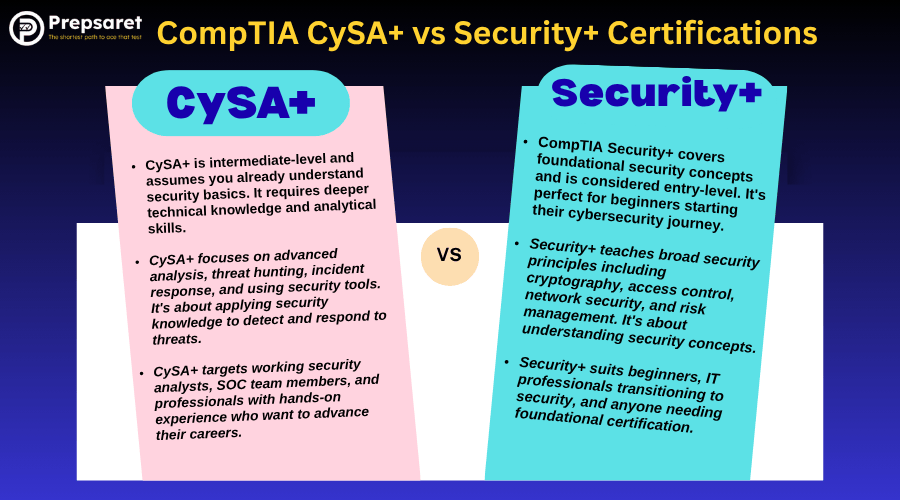
When comparing these two cybersecurity certifications CompTIA offers, beginners often wonder which one to pursue first. The answer depends on your current experience level and how quickly you want to advance.
Difficulty comparison:
- Security+ focuses on broad foundational concepts that are easier to grasp for newcomers
- CySA+ requires deeper analytical thinking and assumes familiarity with security fundamentals
- CySA+ includes more performance-based questions that test practical skills
Skills focus:
- Security+ covers essential security concepts, compliance, threats, and basic security architecture
- CySA+ emphasizes threat detection and analysis, vulnerability management, incident response, and security monitoring
Prerequisites:
- Security+ has no formal prerequisites, making it accessible to beginners
- CySA+ doesn’t require Security+ officially, but CompTIA recommends 3-4 years of hands-on experience or Security+ certification
Both certifications prepare professionals for real-world security roles, but at different levels. Security+ qualifies you for help desk roles with security responsibilities, while the cybersecurity analyst certification (CySA+) positions you for dedicated security analyst positions.
When to Take Security+ Before CySA+
Starting with Security+ before attempting CySA+ offers several strategic advantages. The foundational knowledge you gain makes CySA+ concepts much easier to understand and apply.
Security+ teaches you the vocabulary and basic concepts that CySA+ assumes you already know. Terms like encryption protocols, authentication methods, and attack vectors become familiar through Security+. When you encounter them in CySA+ materials, you can focus on advanced applications rather than struggling with definitions.
CASP+ vs CySA+
Comparing CASP+ and CySA+ reveals distinct differences in career level, technical depth, and target job roles. Understanding these differences helps you plan your certification timeline effectively.
Important note: CASP+ has been retired and replaced by CompTIA SecurityX, which maintains similar advanced-level focus with updated content for modern security challenges.
Career level:
- CySA+ targets intermediate professionals with 3-4 years of experience
- CASP+ (now SecurityX) targets advanced professionals with 10+ years of experience
Technical depth:
- CySA+ focuses on security operations, threat hunting, and vulnerability management
- CASP+ emphasizes enterprise security architecture, risk management, and policy development
Target job roles:
- CySA+ holders work as security analysts, SOC analysts, and threat intelligence analysts
- CASP+ holders work as security architects, senior security engineers, and security consultants
CASP+ focuses on enterprise security solutions including cloud security, cryptography at scale, and organization-wide risk management. CySA+ focuses on security analysis including log analysis, threat detection, and incident response coordination.
Is CASP+ Higher Than CySA+?
Yes, CASP+ is definitively more advanced than CySA+ in CompTIA’s certification roadmap. The hierarchy follows a clear progression path designed to match increasing responsibility and expertise levels.
In CompTIA’s structured approach, Security+ represents foundation-level knowledge, CySA+ represents intermediate analytical skills, and CASP+ represents advanced implementation and strategic planning abilities. This progression mirrors typical career advancement in cybersecurity roles.
Read more: Is CompTIA CASP+ Worth It for Cybersecurity Professionals?
CASP+ vs CySA+ Job Opportunities
Job opportunities for these certifications differ significantly based on the seniority and scope of responsibilities each credential validates.
CySA+ job roles:
- Security Operations Center (SOC) Analyst
- Cybersecurity Analyst
- Threat Intelligence Analyst
- Vulnerability Analyst
- Security Operations Specialist
CASP+ job roles:
- Security Architect
- Senior Security Engineer
- Security Consultant
- Enterprise Security Manager
- Chief Information Security Officer (CISO) at smaller organizations
Government positions following DoD 8570 requirements often specify CySA+ for intermediate analyst roles, while CASP+ satisfies requirements for senior technical management positions.
CompTIA CySA+ vs CASP+ Salary Comparison
CompTIA CySA+ vs Security+ vs CASP+ salary ranges in 2025:
- CySA+ holders typically earn $85,000-$105,000 annually
- CASP+ holders command $110,000-$130,000+ annually
The CASP salary increases with experience, often exceeding $150,000 for senior positions.
CASP+ vs CISSP
Comparing CompTIA CASP+ (CompTIA Advanced Security Practitioner) and CISSP (Certified Information Systems Security Professional) helps you understand two different approaches to advanced security credentials.
Global recognition:
- CASP+ is primarily recognized in North America, especially in government and defense sectors
- CISSP enjoys worldwide recognition and is often considered the gold standard in cybersecurity
Exam structure:
- CASP+ includes 90 questions completed in 165 minutes with performance-based questions
- CISSP includes 100-150 questions completed in up to 4 hours using adaptive testing
Experience requirements:
- CASP+ recommends 10+ years but has no mandatory experience requirement
- CISSP requires 5 years of paid work experience in security (or 4 years plus a degree)
Focus areas:
- CASP+ emphasizes technical implementation and hands-on security skills
- CISSP emphasizes management, governance, and strategic security planning
Both CompTIA security certifications and CISSP carry significant weight with employers, but they target slightly different career trajectories.
CASP+ vs CISSP Career Path Differences
The career paths these certifications support diverge based on whether you prefer hands-on technical work or strategic management responsibilities.
- CASP+ career focus: CASP+ (now SecurityX) focuses on hands-on technical implementation of security controls. Professionals with this certification excel at designing and deploying security solutions, conducting security assessments, and solving complex technical security challenges. You’ll work directly with security tools, architectures, and technologies.
- CISSP career focus: CISSP emphasizes management, risk, and policy-level decision-making across eight security domains. CISSP holders typically move into management positions, become security directors, or take on chief security officer roles. The certification prepares you for strategic planning, budget management, and organizational security leadership.
Read more: CompTIA CASP+ vs CISSP: Which is Better?
Which CompTIA Certification Is Best?
The “best” CompTIA certification depends entirely on your current experience level and specific career goals. No single certification suits everyone—each serves a distinct purpose in your professional development.
Factors to consider when choosing:
- Your current knowledge level and hands-on experience
- Career goals (technical specialist vs. management track)
- Job requirements in your target market
- Time and budget available for study and testing
- Interest in specific security domains
Each certification suits a specific stage of cybersecurity progression. Trying to skip levels rarely works well because each builds essential knowledge for the next. Security+ gives you the language and concepts, CySA+ develops analytical skills, and CASP+ integrates everything into enterprise solutions.
Best CompTIA Certification for Cybersecurity Professionals

Matching certification to the career stage maximizes your return on study time and exam investment. Here’s how to align your choice with where you are professionally.
- Beginners: Start with Security+ If you’re new to cybersecurity or transitioning from another IT field, Security+ provides the perfect entry point.
- Intermediate analysts: Move to CySA+ After gaining 2-3 years of security experience, CySA+ elevates your skills to intermediate level.
- Advanced professionals: Target CASP+ With 7-10 years of security experience, CASP+ (now SecurityX) demonstrates advanced expertise in enterprise security.
What Order Should I Take CompTIA Certifications?
Following the logical progression within CompTIA’s cybersecurity pathway ensures you build knowledge systematically. Skipping steps often leads to knowledge gaps that hurt both exam performance and job effectiveness.
Should I Get Security+ Before CySA+?
Taking Security+ first is highly recommended for most candidates pursuing the CompTIA career path. The foundational understanding it provides makes CySA+ studies significantly easier and more meaningful.
Security+ covers essential topics that CySA+ assumes you already understand. Concepts like TCP/IP protocols, cryptographic fundamentals, access control models, and basic security tools appear in CySA+ materials without detailed explanation.
However, experienced professionals may skip directly to CySA+ in certain situations. If you have 3-5 years of hands-on security experience, especially in SOC or analyst roles, your practical knowledge may already exceed Security+ requirements. Review CySA+ practice questions to assess whether you need Security+ first.
Suggested Certification Progression Path
A comprehensive certification journey extends beyond CompTIA to include other respected credentials. Here’s an optimal progression that builds marketable expertise systematically.
Phase 1: Foundation Security+ → Establishes core security knowledge and makes you employable in entry-level positions
Phase 2: Intermediate Specialization CySA+ → Develops analytical abilities and qualifies you for dedicated security analyst roles
Phase 3: Advanced Technical CASP+/SecurityX → Validates enterprise security skills and senior technical expertise
Phase 4: Optional Specialization
- CISSP for management and leadership roles
- CEH for penetration testing skills and ethical hacking
- CISM for security governance and program management
- Cloud certifications (AWS Security, Azure Security) for cloud security specialization
This progression typically takes 4-7 years depending on study pace and work experience gained between certifications. Don’t rush—each certification becomes more valuable when backed by relevant work experience.
CySA+ vs Security+ vs CASP+ Difficulty Level
Understanding the difficulty differences helps set realistic study expectations and preparation timelines. Each exam challenges candidates differently based on content depth and required experience.
Security+ difficulty:
- Content depth: Covers broad concepts at foundational level
- Exam format: 90 questions in 90 minutes, including performance-based questions
- Study time: 2-3 months for beginners with consistent study
- Pass rate: Approximately 75% on first attempt
CySA+ difficulty:
- Content depth: Covers analytical processes at intermediate level
- Exam format: 85 questions in 165 minutes, including complex performance-based scenarios
- Study time: 3-4 months even with Security+ background
- Pass rate: Approximately 65% on first attempt
CASP+ difficulty:
- Content depth: Covers enterprise security at advanced level
- Exam format: 90 questions in 165 minutes with complex multi-step scenarios
- Study time: 4-6 months with several years of experience
- Pass rate: Approximately 60% on first attempt
The difficulty progression reflects increasing technical depth and practical application requirements at each level.
Which Is Harder, CySA+ or Security+?
CySA+ is definitively harder than Security+ for most candidates. The increased difficulty stems from deeper technical content, more complex scenarios, and expectations of analytical thinking rather than recall.
Security+ tests whether you understand security concepts and can recognize correct approaches to common security situations. Questions often follow predictable patterns, and answers are more straightforward once you know the material.
CySA+ tests whether you can analyze security data, interpret findings, and determine appropriate responses to complex threats. Questions present realistic scenarios with multiple viable options, requiring you to choose the best approach based on context.
Read more: CompTIA CYSA+ vs Security+: Key Differences, Salary & Career Paths
CompTIA CySA+ vs Security+ vs CASP+ Salary
Salary differences across these three certifications reflect the value employers place on each expertise level. These figures represent mid-career professionals in major metropolitan areas. Actual salaries vary based on location, industry, employer size, and individual experience.
- Security+: Entry to junior roles earning $65,000-$85,000
- CySA+: Intermediate analyst roles earning $85,000-$105,000
- CASP+: Senior technical roles earning $110,000-$130,000+
Geographic location significantly impacts these ranges. Security professionals in San Francisco, New York, or Washington DC typically earn 20-30% more than the national average. Remote positions increasingly offer competitive salaries regardless of location.
Salary Growth by Certification Level
Career progression through CompTIA certifications correlates with steady salary increases as you gain both credentials and experience.
- Security+ salary expectations: Entry-level professionals with Security+ certification typically start at $65,000-$75,000. With 2-3 years of experience, this grows to $75,000-$85,000. Security+ alone rarely commands six-figure salaries without extensive experience or additional certifications.
- CySA+ salary expectations: Professionals holding CySA+ certification enter intermediate roles at $85,000-$95,000. With 4-6 years of total experience and proven analytical skills, salaries reach $95,000-$105,000. Senior analysts with CySA+ and specializations can exceed $110,000.
- CASP+ salary expectations: Advanced professionals with CASP+ certification and significant experience command $110,000-$130,000+ in senior technical roles. Security architects and senior consultants with CASP+ often earn $130,000-$150,000. Combined with management responsibilities, salaries can exceed $150,000-$180,000.
The salary progression demonstrates clear financial incentives for continued certification advancement throughout your career.
Is CySA+ Worth It?
The current job market strongly favors CySA+-certified professionals, making this certification a worthwhile investment for intermediate cybersecurity practitioners.
Security analyst positions remain among the fastest-growing roles in technology. The Bureau of Labor Statistics projects 35% growth through 2031, far exceeding average job growth. CySA+ specifically validates skills employers need for SOC operations, threat hunting, and vulnerability management.
Benefits of Earning CySA+ Certification
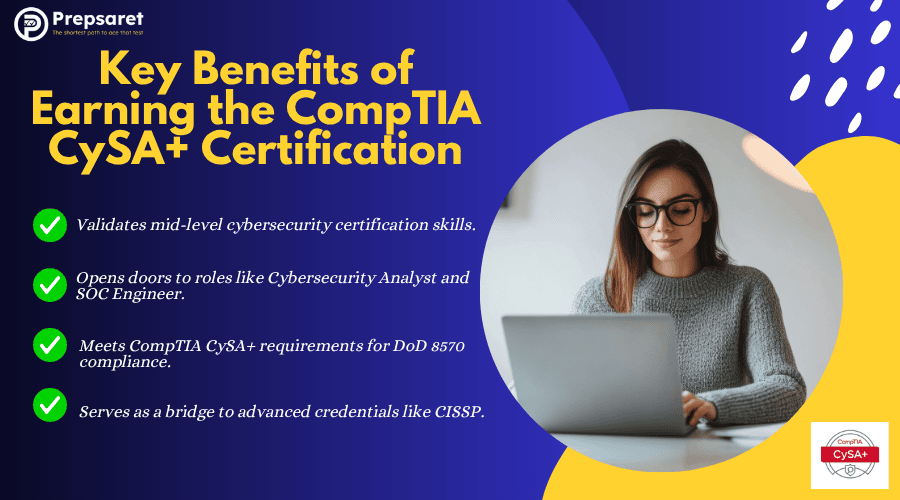
Earning the cybersecurity analyst certification (CySA+) delivers tangible professional benefits beyond just adding credentials to your resume.
Key advantages include:
- Hands-on skill validation: Unlike purely theoretical certifications, CySA+ validates practical abilities in security analytics, vulnerability assessment, and incident response through performance-based questions.
- DoD 8570 requirements compliance: CySA+ satisfies DoD 8570.01-M requirements for Information Assurance Technical Level II positions, opening government and contractor opportunities.
- Global credibility: CompTIA certifications enjoy worldwide recognition, making CySA+ valuable regardless of where you work or plan to relocate.
- Improved employability: Job postings increasingly specify CySA+ or equivalent certifications, making you a stronger candidate for analyst positions.
- Salary increase potential: Most professionals report 10-15% salary increases after earning CySA+, particularly when combined with job changes.
- Career confidence: Validating your skills through certification builds professional confidence and credibility with colleagues and management.
Read more: Is CompTIA CySA+ Worth It? Salary, Jobs & Certification
Prepare for Your CySA+ Exam with Prepsaret
Effective CySA+ preparation requires more than reading books—you need realistic practice that simulates actual exam conditions. Prepsaret’s CySA+ practice test questions with answers help learners master all CySA+ exam domains through hands-on question practice.
The platform offers both free and premium tests aligned with the latest CS0-003 objectives, ensuring your study materials match current exam content. Questions cover Security Operations, Vulnerability Management, Incident Response, and Reporting domains in proportions matching the real exam.
Regular practice with Prepsaret builds speed, accuracy, and confidence simultaneously. The immediate feedback helps you learn from mistakes before taking the actual exam.
Take Prepsaret’s free CySA+ practice tests today to boost your confidence and exam readiness before scheduling your certification exam!
FAQs about CompTIA CySA+ vs Security+ vs CASP+
What's Better, CySA+ or Security+?
Neither is universally better—they serve different purposes. Security+ establishes foundational knowledge for newcomers, while CySA+ validates intermediate analytical skills. For beginners, Security+ is better. For those with experience seeking analyst roles, CySA+ is better. Follow the progression path for optimal career development.
Is CASP Above CySA?
Yes, CASP+ (now SecurityX) sits above CySA+ in CompTIA's certification hierarchy. CASP+ is the advanced-level certification requiring broader knowledge and deeper expertise across enterprise security domains. CySA+ is the intermediate level focused on security analysis and operations.
Is CASP Higher Than Security+?
Yes, CASP+ is significantly higher than Security+ in both difficulty and career level. Security+ is entry-level while CASP+ is advanced, representing completely different expertise tiers.
Is CySA+ Worth It in 2025?
Absolutely. CySA+ remains highly valuable in 2025 due to strong job market demand for security analysts and the certification's alignment with current threat landscapes.
Does CASP+ Renew CySA+?
Yes, earning CASP+ automatically renews your CySA+ certification under CompTIA's Continuing Education (CE) program. Higher-level certifications satisfy renewal requirements for lower-level ones in the same pathway. This means maintaining CASP+ also keeps your CySA+ and Security+ certifications active, simplifying credential management.
Start Your Cybersecurity Certification Journey Today!
Security+, CySA+, and CASP+ each fit different stages of cybersecurity growth and professional development. Identify which certification matches your current skill level and career goals, then commit to systematic preparation.
Begin your CySA+ preparation with Prepsaret’s free practice exam questions to build practical skills and prepare for certification success. Start practicing today and track your progress toward becoming a certified security analyst!